
Most of us have searched for ways to get a smaller waist and found endless tips promising quick results that rarely work.

A slimmer waistline comes from reducing overall body fat through a calorie deficit, building core strength, and improving posture. Targeting one specific area with crunches or restrictive gadgets? That just doesn’t work.
A calorie deficit simply means your body is using more energy than you’re taking in from food, whether through eating less, moving more, or both.
We’ve all fallen for a waist-slimming myth or two. Maybe you tried endless side bends or believed certain foods could spot reduce fat from your waist. The truth? Many popular beliefs about shrinking your waist aren’t supported by scientific evidence.
Knowing what actually works can save you so much time and frustration.
This guide skips the nonsense and focuses on what actually helps you create a more defined waistline. We’ll dig into the science behind fat loss, point out which exercises actually strengthen your core, and highlight daily habits that make a real difference.
Key takeaways

The science behind waist size and fat loss
Your waist size comes down to two things: the fat stored around your middle and the structure beneath it.
You can’t pick where fat disappears, but understanding how your body loses weight helps you set realistic goals and skip the gimmicks.
Understanding core muscles and fat distribution
Your core muscles sit underneath the fat around your abdomen. They include the rectus abdominis (that “six-pack” muscle), obliques along your sides, and deeper stabilising muscles like the transverse abdominis.
-
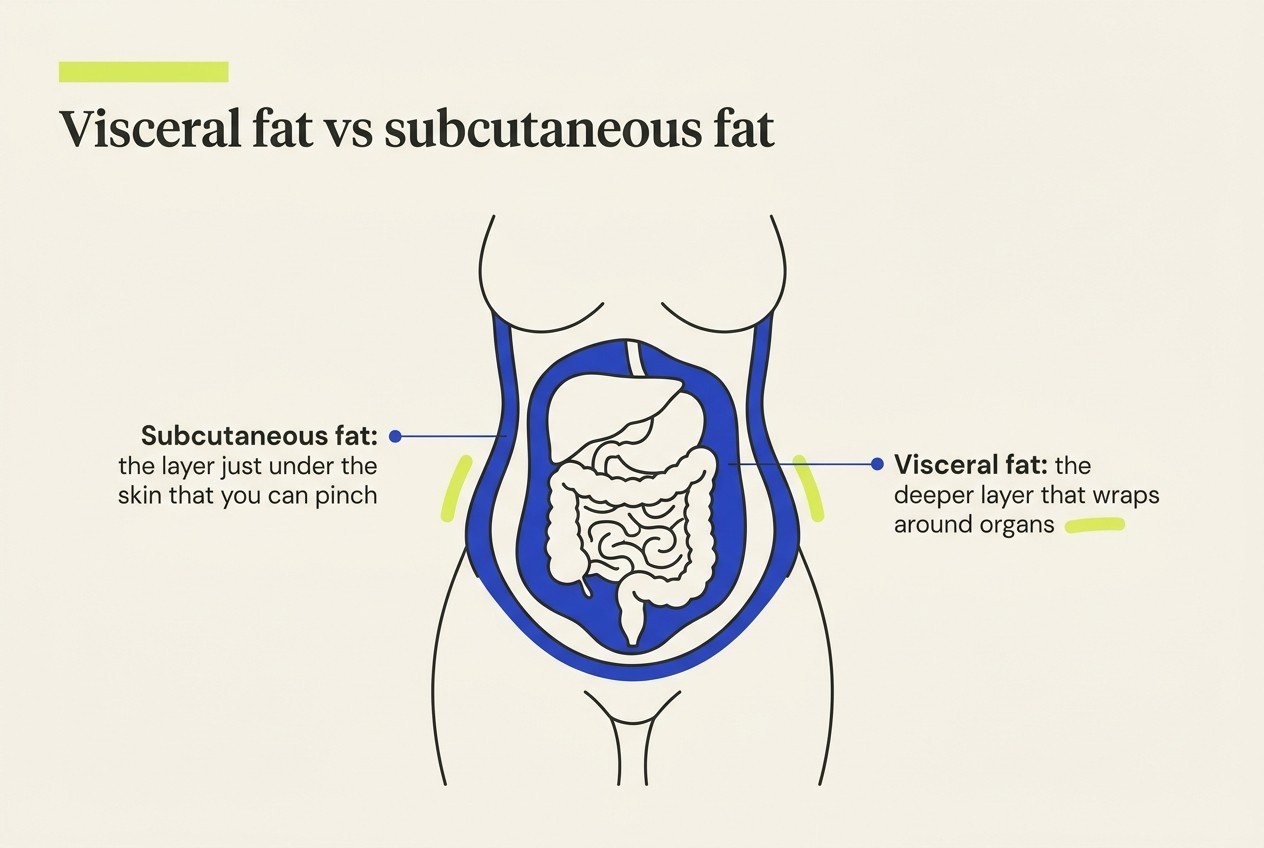
Strong core muscles won’t shrink your waist by themselves. They help your posture and make you look more upright, but they’re under the pinchable subcutaneous fat layer — the soft fat just beneath your skin that you can grab with your fingers.
-
Visceral fat is different: it’s the deeper fat that wraps around your internal organs. You can’t pinch it, but it’s the type most strongly linked to cardiovascular disease, type 2 diabetes, and other serious health conditions.
This type of fat responds well to overall fat loss through calorie deficit. GLP-1 medications (like Wegovy and Ozempic) mimic a natural hormone that reduces appetite and helps you feel full longer. They work on calorie intake, not on changing where your body stores fat.
Hormones and sex play a role in where your body stores fat. Women usually store more fat around their hips and thighs, while men tend to collect it around the waist in that classic “apple” shape.
Spot reduction myths and the truth about fat loss
You can’t target fat loss from your waist by doing endless crunches or wearing waist trainers. This myth just won’t die, but bodies don’t work that way. Core exercises strengthen your muscles and can change how you carry yourself. They won’t melt away the fat on top.
When you burn calories through a deficit, your body draws from fat stores all over. Genetics decide which areas lose fat first and which are stubborn.
For a lot of people, the waist is actually one of the last places to slim down.
A strong core matters for stability, posture, and everyday movement. But if you want a slimmer waist, you need to lose overall body fat.
Your medication helps you create that deficit. Pair it with resistance training to keep your muscle mass as you lose weight.
More muscle helps you maintain your metabolism as your weight drops.
Why genetics and body type matter
Some people just carry more weight around their middle thanks to genetics. If your family has an apple shape, your waist might be the last place to change.
Age affects fat distribution too. As oestrogen drops during perimenopause and menopause, women often notice more belly fat, even if their weight stays the same. That’s hormonal, not a personal failure.
Body type matters for your expectations. If you have a naturally straight torso, you won’t get an hourglass shape just by losing fat.
Your bone structure, rib cage width, and hips set your basic frame.
You can still work towards a smaller waist measurement. Knowing your starting point helps you set goals that make sense.
Losing belly fat improves health markers like blood pressure, insulin sensitivity (how efficiently your body processes sugar), and cardiovascular risk, even if your waist isn’t dramatically cinched. Reducing visceral fat in particular has a meaningful impact on your heart health and metabolic function.
Effective exercise strategies for trimming your waist
Building a smaller waist isn’t about endless crunches or ab challenges. You need smart exercises that strengthen deep core muscles, burn calories through cardio, and improve posture for a more defined midsection.
Deep core training and must-do waist workouts
The transverse abdominis acts like your body’s natural corset. Strengthening this deep core muscle creates a tighter, more compact waistline.
Most people ignore it and just hammer away at surface muscles.
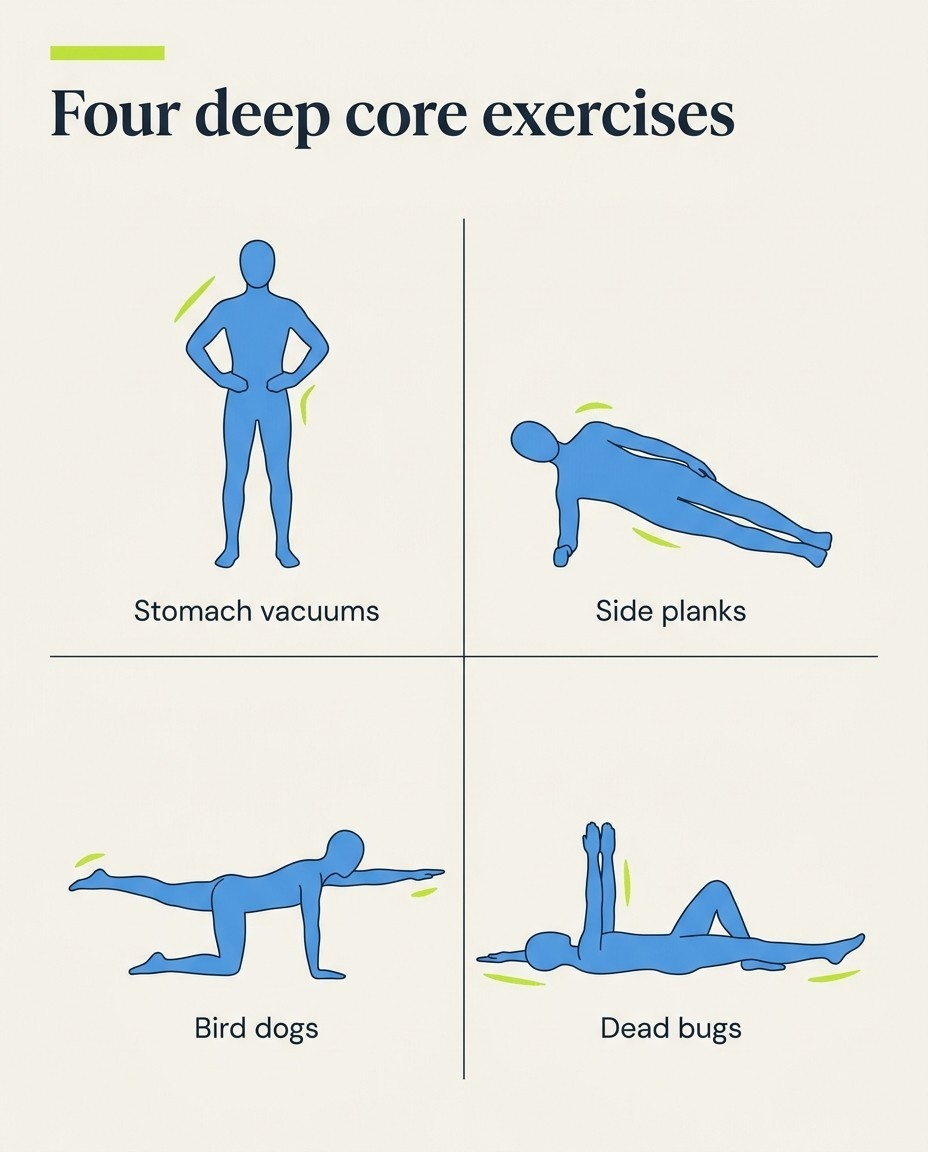
Stomach vacuums are effective for targeting the transverse abdominis. Stand up straight, exhale all your air, then pull your belly button in towards your spine as far as you can. Hold for 10-15 seconds. It feels weird at first, but it directly trains the muscle that pulls your waist in.
Side planks work your obliques and engage your deep core. Hold for 30-45 seconds on each side. If that’s too much, drop your bottom knee for support.
The bird dog is another solid option for core stability. Start on all fours, extend your right arm forward and left leg back, hold for three seconds, then switch sides. It looks simple but really engages your whole core and improves balance.
The dead bug is another top deep core move. Lie on your back, arms straight up, knees bent at 90 degrees. Slowly lower your right arm overhead while straightening your left leg. Return to start and switch sides. Keep your lower back pressed into the floor.
Best abdominal exercises for definition
After building core strength, these moves help create visible definition in your rectus abdominis (the six-pack muscle) and obliques.
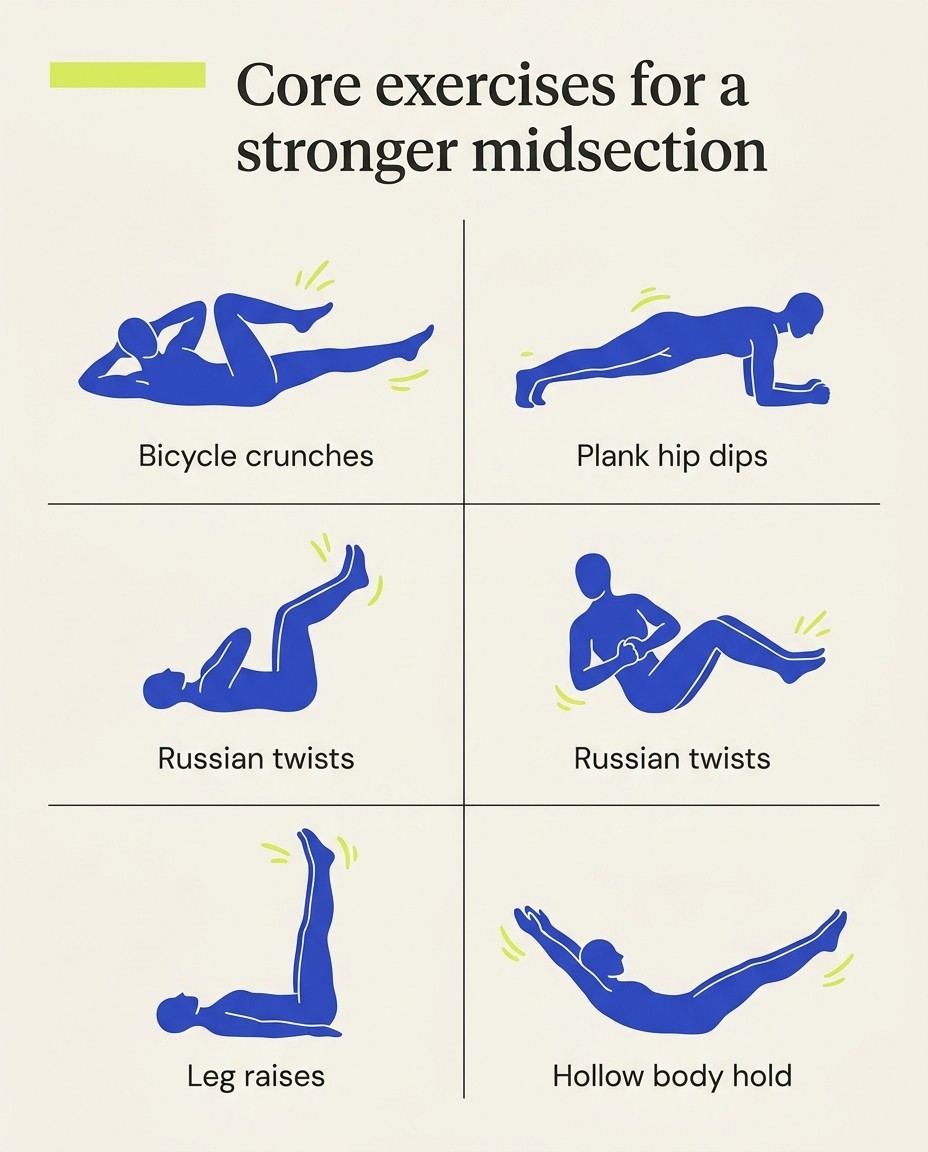
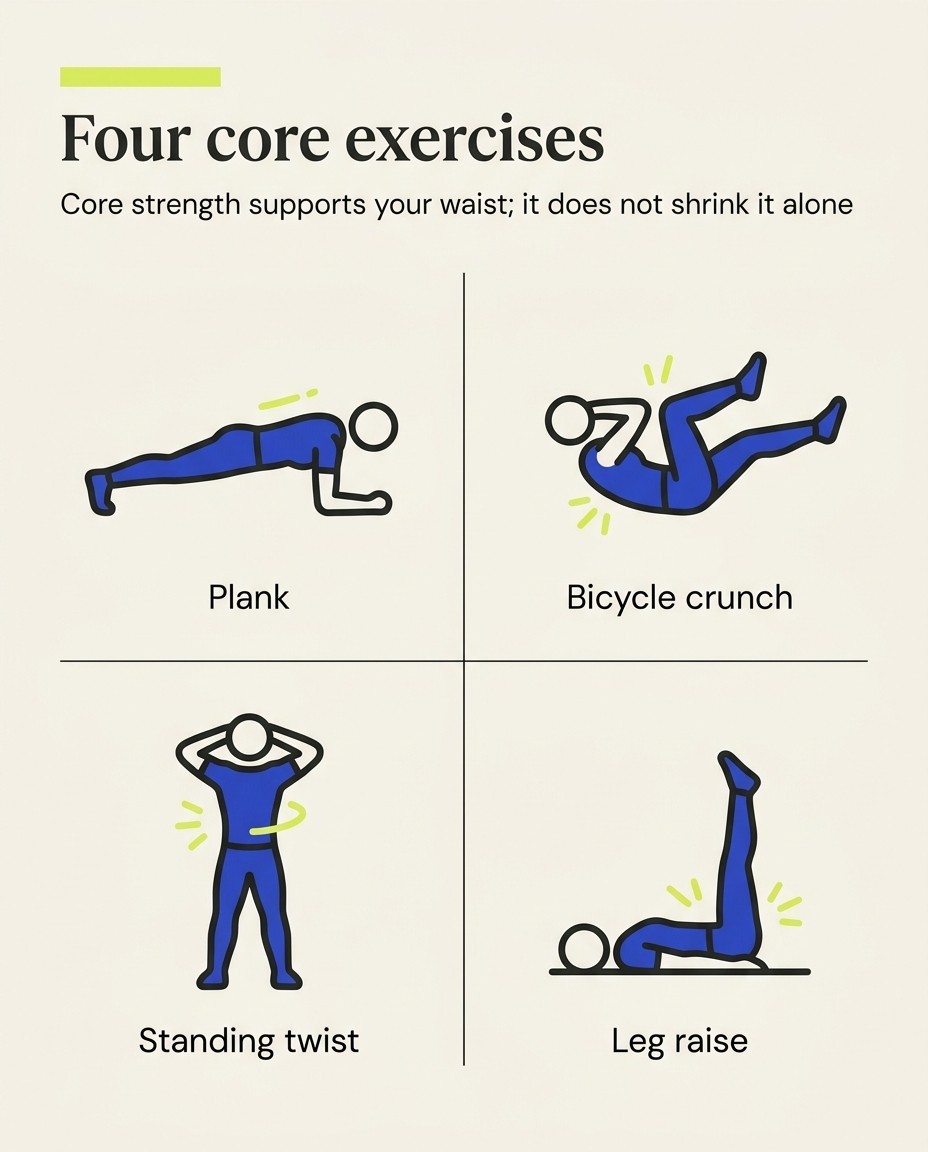
Bicycle crunches rank high for ab work. Lie on your back, hands behind your head, and bring your right elbow to your left knee while extending your right leg. Alternate sides in a pedalling motion. Go for control, not speed.
Plank hip dips combine core stability with oblique work. Hold a forearm plank, then rotate your hips to tap your right hip towards the floor, back to centre, then tap your left hip down. Keep your shoulders steady.
Russian twists target your obliques. Sit on the floor, lean back a bit, lift your feet, and rotate your torso side to side. Hold a weight or water bottle if you want more challenge. Your lower abs work to keep you balanced.
Leg raises hit the lower portion of your rectus abdominis. Lie flat, hands under your glutes, and slowly lift both legs up to 90 degrees, then lower them down without touching the floor. If your hip flexors take over, bend your knees a little.
The hollow body hold is a killer for your whole core. Lie on your back, press your lower back into the floor, lift your shoulders and legs a few inches off the ground, and hold. Your abs will be working overtime to keep you in position.
High-intensity interval training (HIIT) and cardio workouts
Cardio creates the calorie burn you need to show off the muscles you’re building. HIIT works well here because it burns calories during and after your workout.
A basic HIIT workout could be 30 seconds of high knees, 30 seconds rest, 30 seconds of mountain climbers, 30 seconds rest, and repeat for 15-20 minutes. This style burns more calories in less time than steady-state cardio.
On Zepbound or Wegovy, your energy might be up and down. Some days you’ll crush intense cardio, other days a brisk 20-minute walk is all you’ve got.
Both make a difference. The NHS recommends at least 150 minutes of moderate activity per week, but any movement counts. The medication is already creating your calorie deficit, so exercise doesn’t have to be extreme.
Mix in steady-state cardio (like a 30-minute walk) with two or three HIIT sessions each week. This combo supports fat loss and doesn’t overwhelm your body, which is especially helpful when you’re getting used to medication side effects.
If you experience severe nausea, dizziness, or unusual pain during exercise while taking weight loss medication, stop and rest. Speak to your GP or prescriber if these symptoms persist, as your dose or exercise intensity may need adjusting.

Speak to your GP before starting a new exercise programme if you:
- Have recently started or changed your dose of Zepbound, Wegovy, or another GLP-1 medication
- Experience persistent dizziness, chest pain, or joint pain during exercise
- Have any cardiovascular conditions or other health concerns that may affect your ability to exercise safely
Posture and core stability movements
Poor posture makes your waist look thicker than it is. If you slouch, everything compresses forward.
Better posture instantly creates a longer, leaner look and strengthens the core muscles that support your spine.
-
Plank arm reaches build both core stability and posture. Hold a plank, then slowly reach your right arm forward, hold for two seconds, return, then reach your left arm. Your core works to resist rotation while your upper back gets involved.
-
Thread the needle stretches and strengthens at the same time. Start on all fours, thread your right arm under your body to the left while rotating your torso. Return to start and repeat on the other side. This helps undo the hunch many of us get from sitting all day.
-
V-sits challenge your whole core and require balance. Sit on the floor, lean back, lift your legs, and balance in a V-shape for 20-30 seconds. Your deep core muscles work hard to keep you steady.
-
The single knee crunch with twist combines core strength and functional movement. Lie on your back, bring your right knee in while lifting your left shoulder towards it. This move hits your obliques and rectus abdominis together. Try standing up straight right now. Pull your shoulders back, engage your core, and check out how your waist looks instantly smaller.
Posture makes more of a difference than most people realise. Mixing these stability moves with daily awareness of your body position really does change how your midsection looks and feels.
Lifestyle habits for a more defined waistline
Getting a smaller waist isn’t just about crunches or cutting carbs. The habits that matter most are the ones we tend to overlook: what we eat all day, how much water we’re actually drinking, and whether we’re getting enough sleep when life gets messy.
Balanced diet and nutrition essentials
If you want a slimmer waist, you need a calorie deficit, but honestly, the type of calories you eat matters just as much as how many. When medication already kills your appetite, skipping meals or underfeeding yourself becomes way too easy. That’s a real issue, since your body still needs enough fuel to hang onto muscle while you’re losing fat.
Try to make lean protein the star of every meal. During active weight loss, aim for about 1.0–1.2g per kilogram of body weight daily (higher than the general 0.75g recommendation for healthy adults). If you weigh 80kg, that’s somewhere between 80 and 96g, spread out through your meals. Chicken breast, white fish, Greek yoghurt, eggs, tofu — they all work.
Why bother? Well, protein keeps your muscle on board when you’re dropping weight. If you don’t get enough, your body starts breaking down muscle along with fat. That slows your metabolism and makes keeping a slimmer waistline a lot harder in the long run.
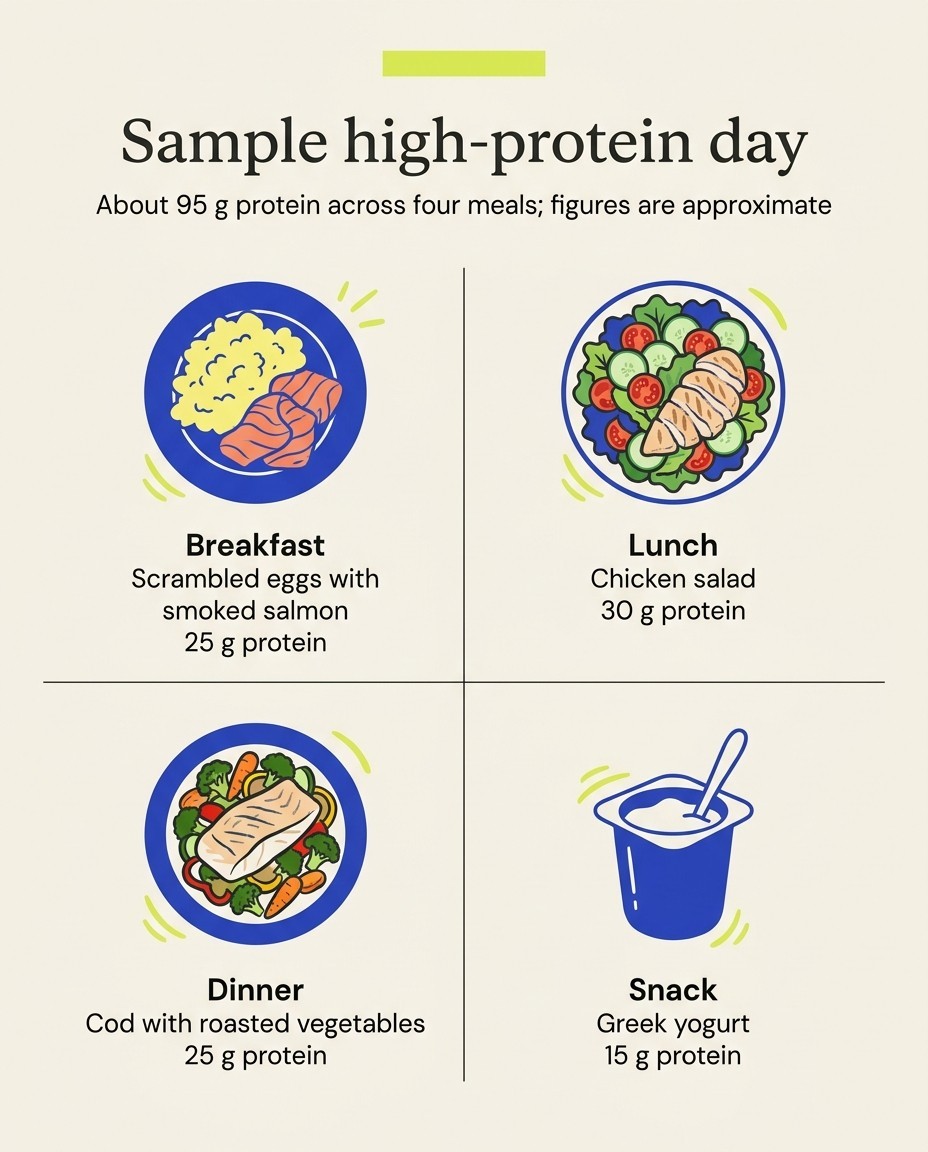
If you’re not really hungry, don’t force food down. But when you do eat, make protein your priority. Research on protein and weight management consistently shows that adequate protein intake during a calorie deficit helps preserve muscle mass and supports long-term results.
Hydration and reducing bloating
Hydration really changes how your waist looks and feels. If you get dehydrated, your body clings to water, and that shows up as bloating around your middle. It sounds a bit counterintuitive, but drinking more water actually helps your body let go of excess.
Aim for at least 2 litres of water daily. The NHS Eatwell Guide recommends 6–8 glasses of fluid daily as a baseline, but if you’re exercising or it’s hot, you may need closer to 2.5–3 litres. Nausea can make this tricky, but sipping small amounts throughout the day is easier than chugging a whole glass at once.
Certain foods just make bloating worse:
-
Fizzy drinks (even the diet ones)
-
High-sodium processed foods
-
Artificial sweeteners like sorbitol
-
Too many cruciferous veggies (broccoli, cauliflower, Brussels sprouts)
Salt sneaks in everywhere. Ready meals and restaurant food can pack 3 to 4g of sodium in a single serving, which leads to water retention. Cooking at home gives you control over the salt.
Coffee and alcohol both draw water out of you, so your body tries to hang onto whatever it can. If you’re drinking either, it helps to add an extra glass of water.
The role of sleep and stress management
Bad sleep ramps up cortisol, the stress hormone that loves to store fat around your waist. One rough night won’t wreck your progress, but consistently getting less than 7 hours really works against your balanced diet and exercise.
When you’re tired, you crave quick fixes, usually high-sugar, high-fat snacks. Your hunger hormones get disrupted: ghrelin (which tells your brain you’re hungry) goes up, while leptin (which signals you’re full) becomes less effective. So portion control? Yeah, that goes out the window.
Stress messes with your waist, too. High cortisol from ongoing stress encourages your body to stash fat around your belly. We can’t erase stress, but we can change how we react to it.
Simple stress management strategies:

Sleep quality isn’t just about hours. Keep your bedroom cool (16 to 18°C), dark, and quiet. If you can, avoid screens for an hour before bed. Your body repairs itself during deep sleep, including muscle recovery from workouts.
Common mistakes and smart tips for sustainable results
Most people get frustrated about their waist because they’re either doing too much of the wrong thing or expecting changes way too fast.
Overtraining the obliques and other pitfalls
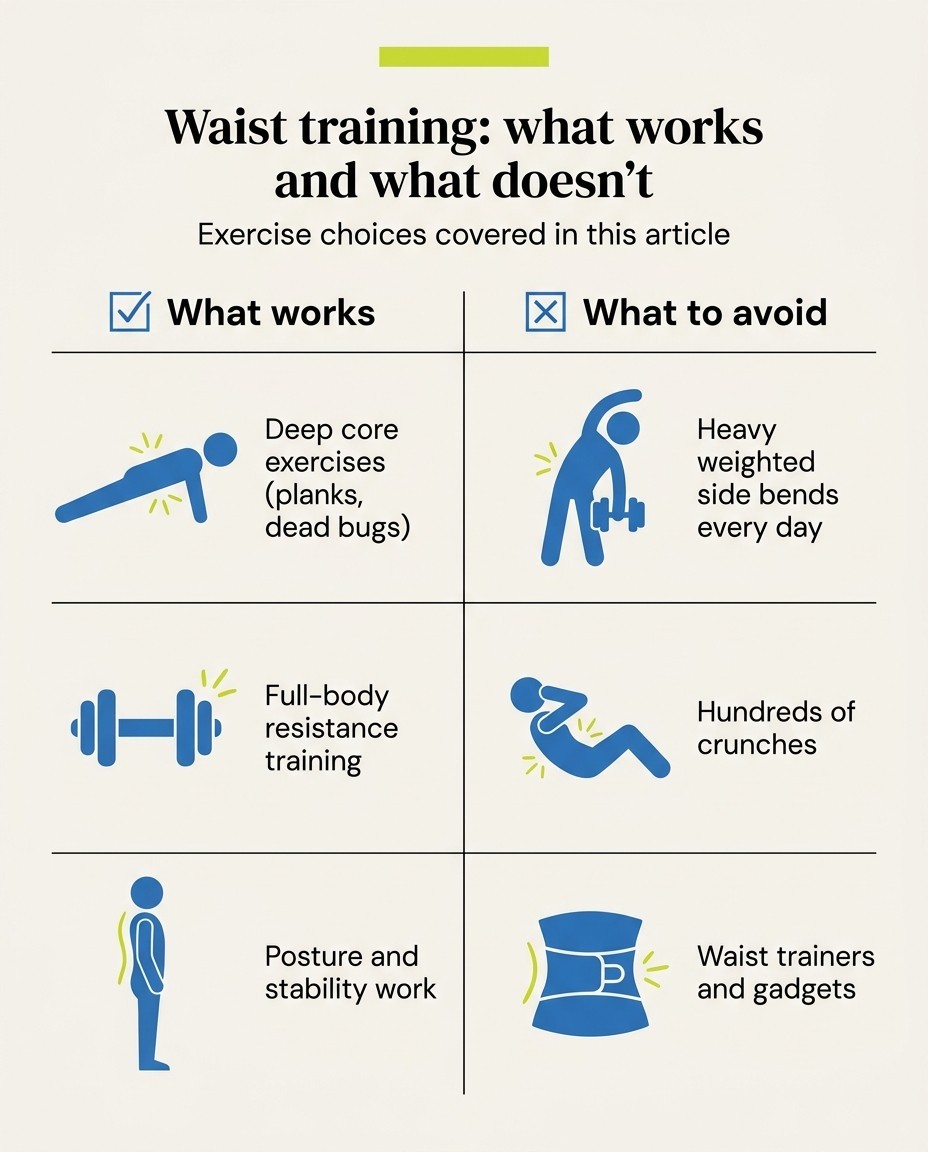
You’ve probably seen those endless side bend routines that promise a cinched waist. But here’s the thing: if you overwork your obliques, your waist can actually look wider. Those muscles run down your sides, and if you build them up without balance, they add bulk instead of definition.
Common training mistakes that backfire:
- Doing heavy weighted side bends or oblique crunches every day
- Ignoring deep core muscles (like the transverse abdominis) that actually pull your waist in
- Doing hundreds of twisting moves with bad form
- Skipping compound exercises that burn more calories overall
So, what actually helps? Focus on core strength with moves like planks, dead bugs, and pallof presses. These build the inner muscles that support your posture and naturally pull your waist in. Add in full-body resistance training to burn more belly fat overall, and you’ll see way better results than with endless ab work.
Setting realistic goals and embracing patience
Your waist isn’t going to change overnight. Honestly, that’s tough to accept when you’re putting in the effort, but keeping your expectations grounded will save you from falling for popular diet fads or just throwing in the towel. Sometimes you’ll notice a change, sometimes you won’t see anything for a bit.
Steady fat loss usually trims the waist by about 1–2 cm a month. A 2024 review of 116 trials found that 150 minutes of weekly aerobic exercise — the standard recommendation — reduced waist size by around 2.8 cm over a few months.
Things like water retention, hormones, and even digestion can mess with your measurements from day to day.
Sustainable goal-setting looks like this:
A smaller waist comes from losing overall body fat, not from targeting your midsection with specific exercises or gadgets. Focus on maintaining a calorie deficit, prioritise protein to preserve muscle, and strengthen your deep core muscles for better posture and a more defined shape.
If you’re on Zepbound or Wegovy, the medication is already doing the heavy lifting on your calorie deficit — your job is to support it with resistance training, adequate protein, proper hydration, and decent sleep.
Be patient with the process. Waist measurements change slowly, and genetics play a bigger role than most people realise. Track trends over weeks, not days, and remember that any reduction in waist circumference is genuinely good for your cardiovascular health, even if it feels modest.
Frequently asked questions
Can you actually target fat loss from your waist?
No. Spot reduction is a persistent myth, but research consistently shows you cannot choose where your body loses fat. When you create a calorie deficit, your body draws from fat stores across your whole body. Genetics determine which areas slim down first. For many people, the waist is one of the last places to change.
How long does it take to lose inches from your waist?
Most people can expect their waist to shrink by roughly 1–2 cm per month with consistent fat loss. This varies depending on your starting point, genetics, and how much visceral fat you carry. Visceral fat tends to reduce more quickly than the subcutaneous layer you can pinch.
Do waist trainers actually work?
Waist trainers may temporarily compress your midsection, but they don’t cause fat loss or permanently change your shape. They can restrict breathing, weaken core muscles over time, and cause discomfort. Your time is better spent on deep core exercises like planks and stomach vacuums.
What exercises are best for a smaller waist?
Deep core exercises like stomach vacuums, planks, dead bugs, and bird dogs are most effective because they target the transverse abdominis — the muscle that acts like a natural corset. Combine these with full-body resistance training and some cardio to reduce overall body fat.
Will doing lots of oblique exercises give me a smaller waist?
Overdoing heavy oblique work (like weighted side bends) can actually make your waist appear wider by building bulk along your sides. Focus on deep core exercises instead, and include oblique work in moderation with bodyweight moves like side planks.
Does sleep really affect waist size?
Yes. Poor sleep raises cortisol levels, which promotes fat storage around the abdomen. It also disrupts hunger hormones, making you more likely to overeat. Aim for 7–9 hours per night in a cool, dark room for the best results.
Can weight loss medication help reduce my waist size?
Medications like Zepbound and Wegovy help create a calorie deficit by reducing appetite, which leads to overall fat loss, including around the waist. Pairing medication with resistance training and adequate protein intake helps preserve muscle mass and supports a more defined waistline.
How should I measure my waist accurately?
Measure at the narrowest point of your torso, usually just above your belly button. Use a flexible tape measure, stand relaxed (don’t suck in), and measure at the same time each week, ideally first thing in the morning before eating. Track trends over 4–6 weeks rather than comparing day to day.
This guide is for general information only and does not replace medical advice. If you’re taking weight loss medication such as Zepbound or Wegovy, speak to your GP or prescriber before making significant changes to your exercise routine or diet. If you experience unusual pain, dizziness, or other concerning symptoms during exercise, stop and seek medical advice.