

A weight loss plateau happens because your body adapts to your new routine. It burns fewer calories at rest, ramps up hunger signals, and gets more efficient with the energy you give it. This is normal. It’s not proof you’ve failed, or that your treatment isn’t working anymore. Weight loss often slows, stalls or, in some cases, reverses, even if you stick to your plan.
You’ve done everything right. You’re tracking your meals, walking more, drinking water, and taking your medication as prescribed. For weeks, maybe even months, the weight dropped off. Then, out of nowhere, it just stops.
The annoying part is that there’s rarely a simple answer. Your body could be holding onto water from a new workout. Maybe you’re eating more than you realise now that your appetite’s back a bit. Or perhaps dietary changes that worked brilliantly three months ago just aren’t creating enough of a deficit anymore. Here’s what actually causes plateaus and how you can handle them without making yourself miserable.
:::key-takeaways## Key takeaways
-
Weight loss plateaus are a normal biological response, not a sign of failure or that your medication isn’t working
-
Many factors can stall progress: metabolic adaptation, changes in activity, medication effects, or underestimating calories
-
Breaking through a plateau means finding your specific barriers and making targeted tweaks, not just slashing calories
:::
Understanding why weight loss stops
Your body fights back against weight loss in sneaky ways, slowing or pausing progress even when you’re doing everything right. Most early stalls aren’t true plateaus at all.
What is a weight loss plateau?
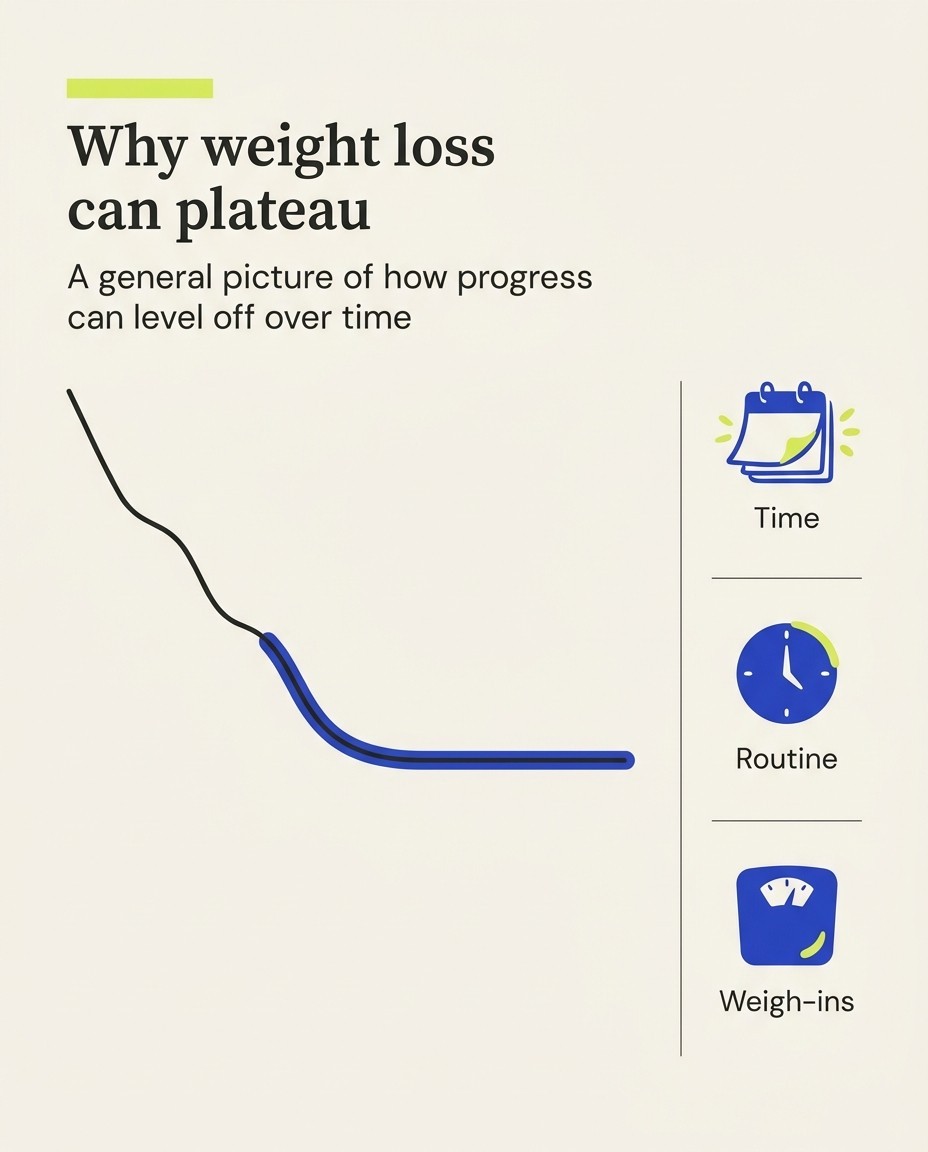
A real plateau means fat loss genuinely stops for several weeks, even though you haven’t changed your medication, eating, or activity. That’s different from the scale refusing to budge for a few days.
A plateau is a pattern that lasts three or four weeks. Your weight stays the same, your measurements don’t change, and your clothes fit exactly like they did a month ago.
Lots of factors can hinder weight loss, even on a structured programme. Your body adapts to eating less, and metabolic rate can drop within days, sometimes more than you’d expect from the weight you’ve lost.
It’s tough because you’re still taking your injections, still eating carefully, still showing up. But a real plateau is different from normal ups and downs.
Initial weight drop versus true fat loss
The first week or two on GLP-1 medication (treatments like Zepbound and Wegovy that mimic a natural appetite-regulating hormone) usually brings a big drop. Maybe you lose 2kg or 3kg, or more. That feels great, but it’s not all fat.
Early weight loss is a mix of some fat, water, and whatever’s in your digestive system. When your appetite drops and you eat less, your body sheds water and uses up glycogen stores.
True fat loss goes slower. After the first couple of weeks, losing 0.5kg to 1kg a week is normal and sustainable. Some weeks you’ll lose more, some less. That’s just how bodies work.
If you expect the first week’s loss to keep going, you’re setting yourself up for disappointment. The scale slowing down doesn’t mean your medication quit or you did something wrong.
Water weight, glycogen, and early changes
Your muscles and liver store glucose as glycogen. Each gram of glycogen holds about 3 grams of water. When you eat less, especially fewer carbs, these stores drop fast.
That’s where a lot of early weight loss comes from. You haven’t lost several pounds of fat in five days. You’ve used up glycogen and let go of the water that comes with it.
This also explains why the scale can bounce up overnight, even if you’ve been careful. A meal higher in carbs or salt can refill some glycogen and pull in extra water. It’s not fat gain.
Knowing this helps you stay calm when weight loss seems to stop after a few weeks. You’re still losing fat, but the dramatic water shifts have settled. The process keeps going, just at a more realistic pace.## Key causes of a weight loss plateau
Your body doesn’t want you to lose weight. When you do, it pushes back by burning fewer calories each day, and you might not even notice.
Metabolic adaptation and slower metabolism
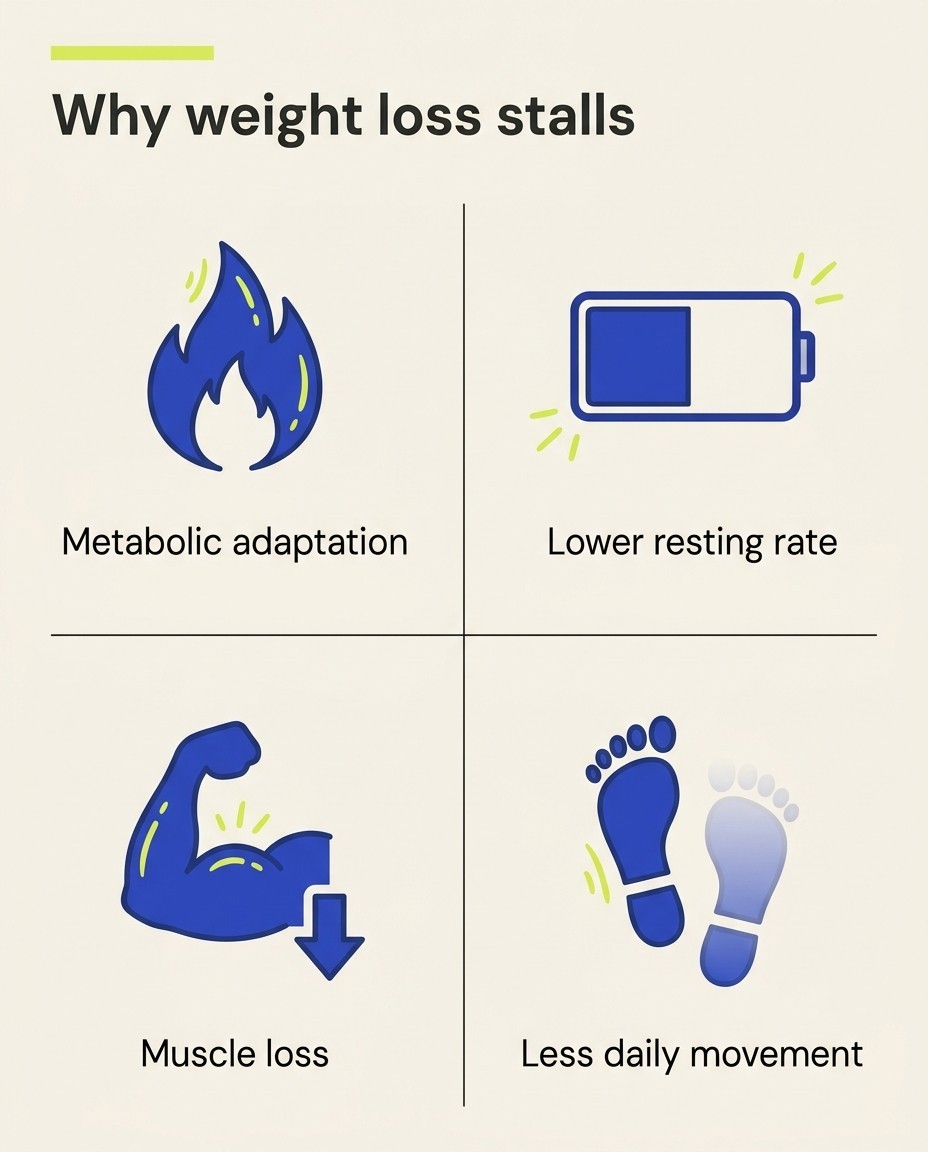
Metabolic adaptation is your body’s survival instinct. As you lose weight, your total daily energy expenditure drops: your body gets more efficient with energy and burns fewer calories doing the same things it did before.
This isn’t a broken metabolism. It’s called adaptive thermogenesis (your body turning down its internal thermostat to conserve energy), and it’s completely normal.
Your body cuts back on the energy it spends on basics like breathing, pumping blood, and keeping you warm. This adaptation can last even after you stop losing weight.
Here’s the tricky part: your body doesn’t warn you when it’s doing this. You’re eating the same calories that worked last month, but now they’re not enough to keep losing.
Decrease in resting metabolic rate
Your resting metabolic rate is how many calories you burn just existing. When you weigh less, you need fewer calories to keep your smaller body running.
A 12-stone person needs less fuel than a 15-stone person, just like a small car uses less petrol than a big one.
One major reason for weight loss plateaus is that as you lose weight, your body needs fewer calories. The drop isn’t tiny either. Lose a stone, and you might burn 100–150 fewer calories a day.
If you’re on Zepbound or Wegovy, this is worth understanding. The medication helps you eat less, but it can’t change the maths of a lower resting metabolic rate.
Muscle mass loss and its impact
When you lose weight, you lose some muscle along with fat. Muscle burns more calories than fat.
Every pound of muscle you lose means you need fewer calories per day. If you’re losing weight quickly or not eating enough protein, you might be losing more muscle than you need to.
Body composition matters. Two people can weigh the same but burn calories at very different rates, depending on their muscle mass.
On GLP-1 meds, muscle loss can become a real problem. Your appetite drops so much that getting enough protein feels impossible. But aiming for at least 1.0–1.2g of protein per kg of body weight helps protect your muscles.
Resistance training helps too. Even twice a week can help you hold onto muscle while losing weight.
Non-exercise activity thermogenesis (NEAT) decline
NEAT covers all the movement you do that isn’t formal exercise: walking to the kettle, fidgeting, taking the stairs, doing chores.
As you lose weight, your NEAT often drops without you noticing. You might take fewer steps, stand less, or move a bit slower. Your body tries to conserve energy by making you a little less active, which can quietly cut your daily energy expenditure by hundreds of calories.
The sneaky part is that you might not feel less active. The changes are subtle. Maybe you sit instead of stand, or drive instead of walk. These little shifts add up.
Try tracking your daily steps. If you’ve gone from 8,000 to 6,000 a day, that’s a real decrease in NEAT that could explain your stalled weight loss.
 ## Lifestyle, habits, and hidden challenges
Sometimes, what’s stalling your weight loss isn’t what you’re eating. It could be how you’re tracking, whether you’re building muscle, or how well you’re sleeping.
Calorie deficit and tracking intake
Your body needs fewer calories now than it did before. That’s just how it works.
If you’ve lost two stone, your maintenance calories have dropped too. What used to be a deficit might now be maintenance. That’s especially true if you started at a higher weight.
Most of us underestimate what we eat by 20–30%. We forget the milk in our coffee, a handful of nuts, or the oil in cooking. Those little things add up, especially when you’re eating less overall.
Try tracking everything for three days. Use a food scale instead of guessing. You might be surprised.
Some people find maintaining weight loss takes constant effort to track and monitor what they eat. That’s normal, not a personal flaw.
If tracking feels exhausting, maybe work with a dietitian who understands GLP-1 meds. They can help you build habits that actually last.
Exercise patterns and strength training
Cardio burns calories while you’re doing it. Strength training helps you build muscle, so you burn more calories all day.
We often focus on steps and forget about getting stronger. Walking is great for health, but it won’t stop muscle loss during weight loss. Only resistance training does that.
You don’t need a fancy gym. Bodyweight moves, resistance bands, or a few dumbbells at home work fine. The key is to keep making things harder over time.
Try for two or three strength sessions a week. The NHS recommends strength exercises on at least two days a week alongside 150 minutes of moderate activity. Focus on moves like squats, push-ups, and rows. These hit several muscle groups at once.
Your body adapts to exercise fast. If you’ve done the same workout for months, it’s probably too easy now. Add weight, add reps, or slow things down to make it tougher.
Stay active throughout the day. A standing desk or regular walks matter more than you think. NEAT can account for a few hundred calories daily.
Stress, sleep, and hormonal factors
Cortisol, your body’s main stress hormone, doesn’t care about your calorie deficit. When you’re stressed, cortisol can increase water retention and drive cravings for high-calorie foods, making your body hold onto weight.
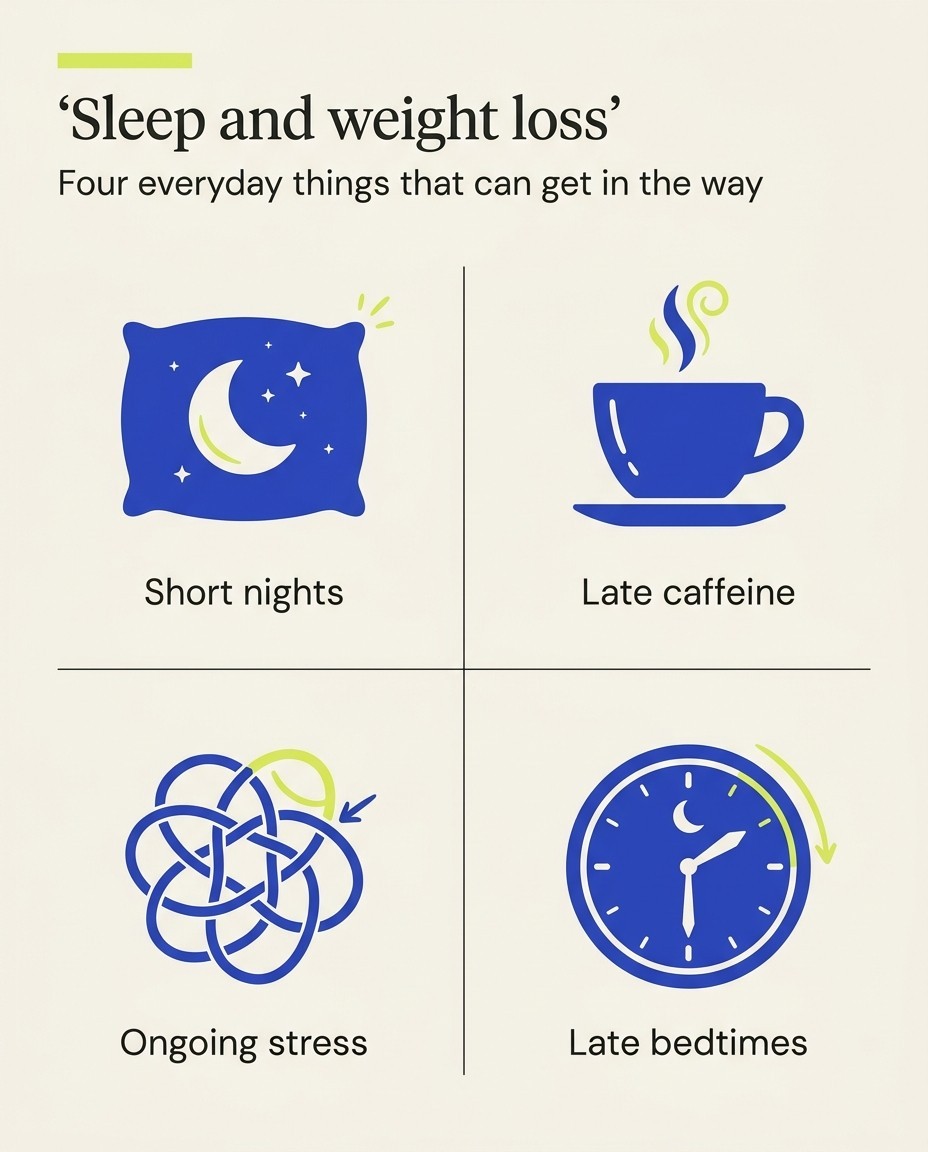
Poor sleep raises ghrelin (the hunger hormone) and lowers leptin (the fullness hormone). You end up hungrier and less satisfied, even if you’re on medication. Most adults need seven to nine hours, not the six we pretend is enough.
Manage stress in practical ways, not just bubble baths. Maybe that means saying no to things, asking for help, or talking to your GP about anxiety. Weight loss journeys can take an emotional toll, and there’s no shame in asking for support. Your GP can discuss options including talking therapies and stress management programmes.
Hormonal shifts matter too. Perimenopause, thyroid, and PCOS can all change how your body responds to treatment. If you’re doing everything right and nothing’s changing, ask your GP to check your thyroid and hormones.
Women often see weight swing by 2–3 pounds during their cycle. That’s water, not fat. Track trends over weeks, not days.
Some meds, like sleep aids, antidepressants, and beta-blockers, can affect weight. Don’t stop anything prescribed, but talk to your GP about options if weight management is important to you.
Set-point theory and weight management
Your body has a weight range it fiercely defends. That’s the set-point theory.
After you’ve kept a lower weight for several months, your metabolism may adapt. You’ll burn fewer calories at rest than someone who’s always been at that weight. It’s not fair, but it’s biology.
That doesn’t mean more weight loss is impossible. It just means it might go slower than you’d like. A slower loss, maybe 0.25–0.5kg per week, is more sustainable anyway.
Some people settle at a weight higher than their goal but lower than where they started. If your health and quality of life improve, that still counts as a win. You can check your BMI using the NHS calculator to understand where you currently sit.
Understanding weight management challenges means accepting that maintenance isn’t a finish line. It’s about small, sustainable habits, over and over.
You can shift your set-point over time with consistent changes. But it takes months, sometimes years, not weeks. Patience isn’t glamorous, but it’s what actually works.
Evidence-based strategies to restart progress
When weight loss stalls, small but targeted changes to your nutrition, activity, and habits can help you move forward again. Often, it’s tweaks to calories, protein, fibre, and strength training that make the difference.
Adjusting calories and macronutrients
As you lose weight, your body just doesn’t need as many calories as before. Even small dietary changes, like slightly larger portions or more snacking, can close the gap between what you’re eating and what you’re burning. The calories that helped you lose weight at first might now be just enough to keep you where you are.
It’s a good idea to check in on your calorie intake every few months. If weight loss stalls for more than three weeks, try dropping 100 to 200 calories a day.
Protein matters even more when you hit a plateau. Aim for about 1.0 to 1.2g of protein per kg of your body weight each day. This helps you keep muscle while you’re still losing fat.
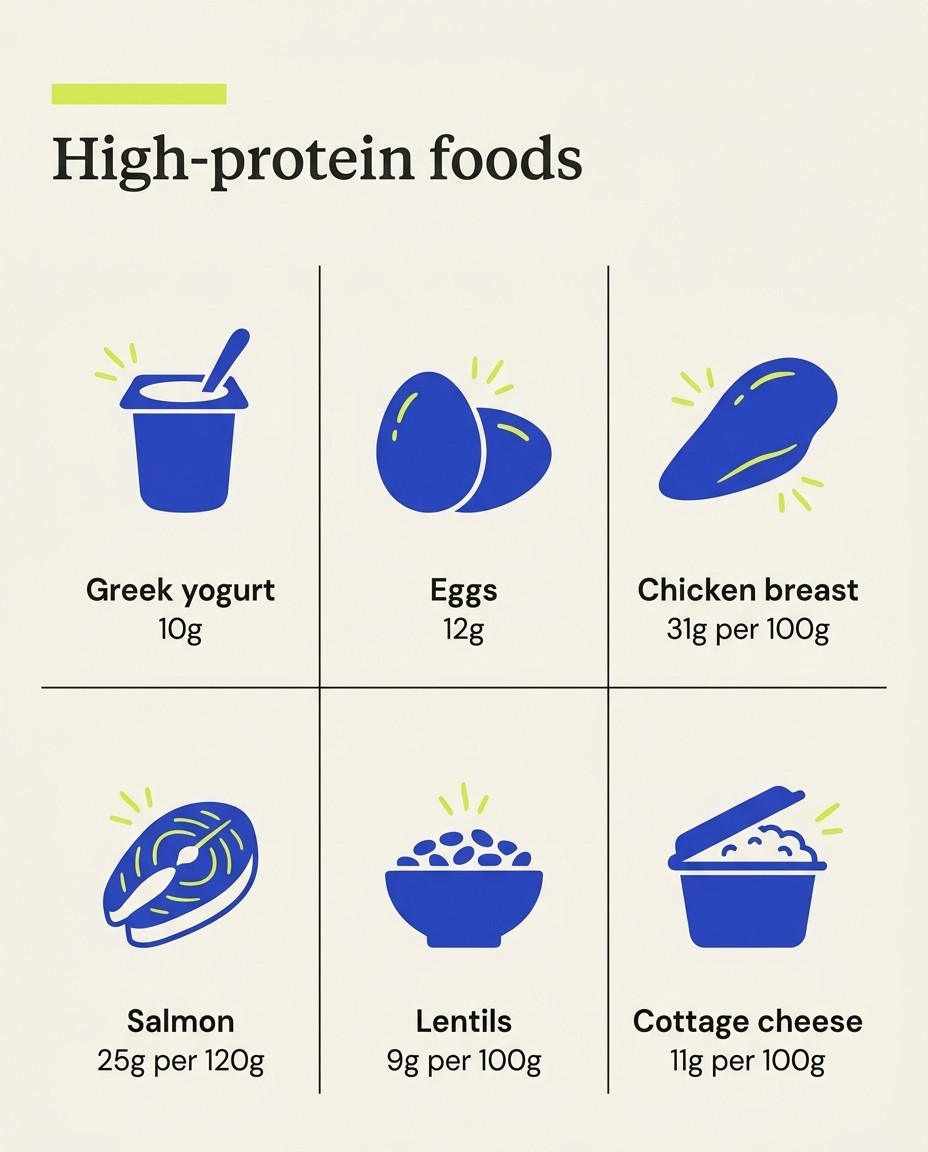
Try spreading your protein throughout the day:
-
Breakfast: Greek yoghurt (10g), two eggs (12g)
-
Lunch: Chicken breast 100g (31g), chickpeas 80g (7g)
-
Dinner: Salmon fillet 120g (25g), lentils 100g (9g)
-
Snacks: Cottage cheese 100g (11g)
That’s roughly 105g of protein for someone who weighs 75kg. You’ll want to tweak these amounts based on your own weight and how hungry you feel, especially if you’re on medication.
Hydration matters too. Aim for at least 2 litres of water daily, as dehydration can mask itself as hunger and slow digestion. The NHS Eatwell Guide recommends 6–8 glasses of fluid daily as a baseline, but you may need more during active weight loss.
Incorporating soluble fibre for satiety
Soluble fibre slows down digestion and helps you feel full longer. It pairs nicely with GLP-1 meds, which already curb your appetite.
Oats, beans, lentils, apples, and flaxseeds are all good sources. Toss a tablespoon of ground flaxseed into your porridge or yoghurt for a quick 2g of soluble fibre. A bowl of lentil soup has about 4g.
Soluble fibre helps with weight control, and you don’t have to overhaul your whole diet. Just start by adding one or two high-fibre foods a day.
Aim for around 30g of total fibre daily, the amount recommended by the NHS. Try to get a mix of soluble and insoluble fibre. Your gut will thank you.
Building and maintaining muscle
Muscle burns more calories at rest than fat does. If you lose weight fast, especially with medication, you might lose muscle along with the fat.
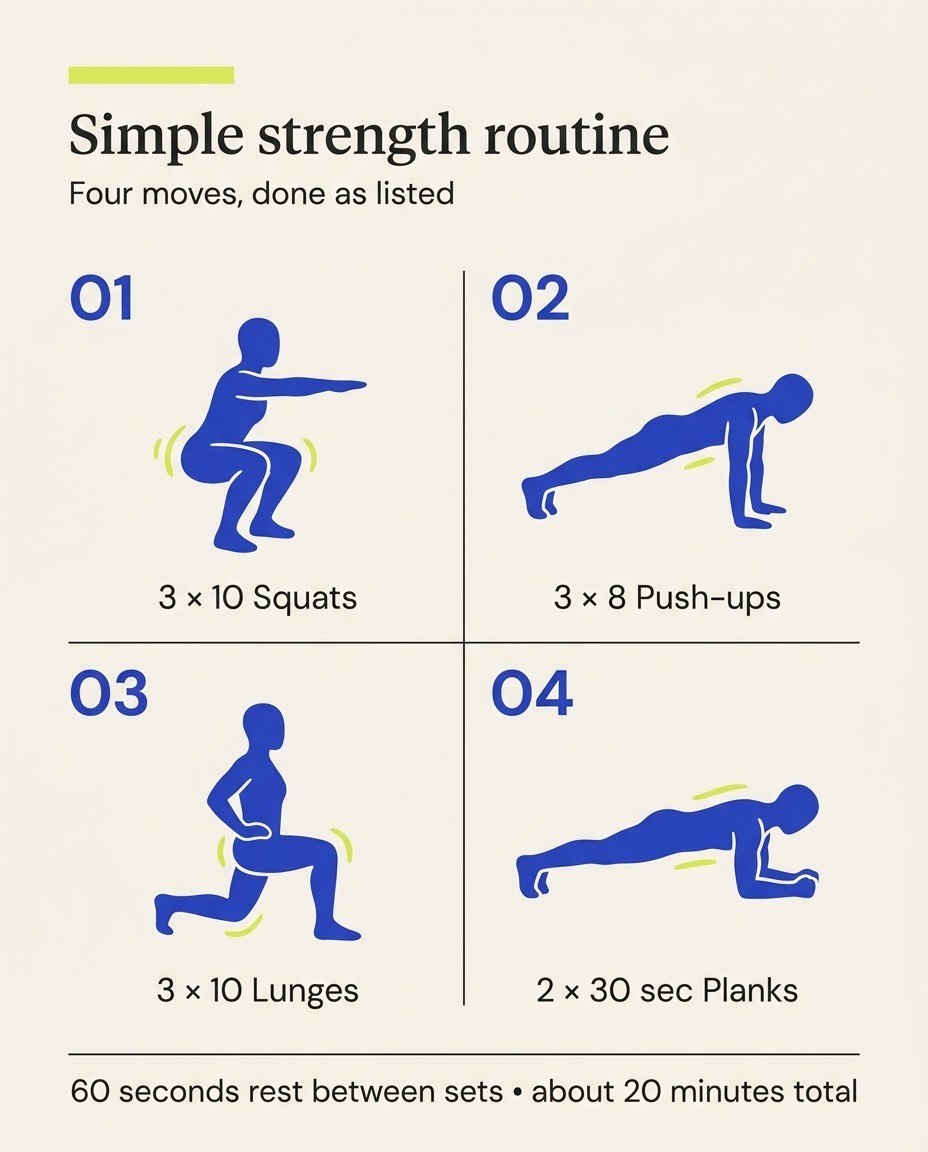
Try to do strength training twice a week to keep your muscle. No need for a gym: bodyweight moves like squats, press-ups, and lunges are enough.
Here’s a simple routine:

Take a 60-second break between sets. The whole thing takes about 20 minutes.
Walking counts, too. Aim for 7,000 to 10,000 steps a day to boost your metabolism and overall health. You don’t have to do it all at once: three brisk 10-minute walks scattered through the day get you there.
Sustaining long-term weight management
Maintaining weight loss takes a different approach than just losing weight. Honestly, most folks put weight back on within a couple of years if they only use medication and don’t build lasting habits.
Focus on routines that fit real life rather than chasing perfection. Planning out three main meals each day can cut down on decision fatigue, especially when you’re just not that hungry.
Batch cooking on weekends makes weekday meals far less stressful.
Try jotting down what you eat in a simple food diary. No need to count every single calorie. Just noticing what you ate and how hungry you were can reveal plenty.
Stay in touch with your GP or prescriber. Checking in every three months lets you tweak your treatment and talk through concerns before they become big problems.
If you’ve been on treatment for over six months, ask about blood tests to keep tabs on your nutrition.
Weight will go up and down, and that’s just part of the process. Hitting a plateau for a few weeks is normal, and it doesn’t mean the medication stopped working or that you’ve messed up.## When to speak to your GP
Not every plateau needs medical attention, but some situations do.

Book a GP appointment if:
- Your weight hasn’t changed for more than six weeks despite consistent effort
- You’re experiencing new or worsening side effects from your medication
- You feel persistently fatigued, cold, or notice hair thinning (possible thyroid or nutritional issue)
- You’re struggling with low mood, anxiety, or disordered eating patterns
- You’ve lost weight rapidly (more than 1kg per week for several weeks) and feel unwell
- You want to discuss adjusting your medication dose

These are normal and usually resolve on their own:
- Weight staying the same for 1–3 weeks
- The scale going up by 1–2 pounds after a higher-carb meal or during your menstrual cycle
- Slower weight loss after the first month of treatment
- Day-to-day fluctuations of up to 1kg
Your GP or prescriber can check for underlying issues like thyroid problems, review your medication dose, and refer you to a dietitian if needed. If you’ve been on treatment for more than six months, ask about blood tests to monitor your nutritional status.
The bottom line
Weight loss plateaus are a normal part of the process, not a sign that your medication has stopped working or that you’ve done something wrong. Your body adapts to weight loss by burning fewer calories, ramping up hunger signals, and becoming more efficient with energy. That’s biology, not failure.
The most effective response is targeted tweaks, not drastic changes. Review your calorie intake, prioritise protein (1.0–1.2g per kg of body weight daily), add or maintain strength training, and pay attention to sleep and stress. If your weight hasn’t budged for more than six weeks despite consistent effort, speak to your GP or prescriber. They can review your treatment plan and check for underlying factors like thyroid issues.
Progress isn’t always visible on the scale. Improved energy, better sleep, clothes fitting differently, and healthier blood results all count.
:::faq-section## Frequently asked questions
How long does a weight loss plateau last?
Most plateaus last two to six weeks. If your weight hasn’t changed for more than six weeks despite sticking to your plan, it’s worth speaking to your GP or prescriber to rule out underlying causes and discuss whether a dose adjustment might help.
Can Zepbound or Wegovy stop working?
The medication doesn’t stop working, but your body adapts to your lower weight by burning fewer calories. This can make it seem like the medication isn’t effective anymore. Your prescriber may suggest a dose increase or review your overall treatment plan if progress has stalled significantly.
Should I eat less to break a plateau?
Cutting calories drastically can backfire: it can increase muscle loss and slow your metabolism further. A modest reduction of 100–200 calories per day is usually enough. Focus on protein intake (1.0–1.2g per kg of body weight daily) and food quality rather than just eating less.
Will exercise help me break through a plateau?
Yes, particularly strength training. Resistance exercises help preserve muscle mass, which keeps your resting metabolic rate higher. Aim for two to three sessions per week alongside your usual walking or other activity. Even bodyweight exercises at home make a difference.
Is it normal for weight loss to slow down after the first month?
Yes. The dramatic weight loss in the first few weeks is largely water and glycogen, not fat. After that initial drop, losing 0.5–1kg per week is a healthy, sustainable rate. Slower progress doesn’t mean your treatment isn’t working.
Could my other medications be causing my plateau?
Some medications, including certain antidepressants, beta-blockers, corticosteroids, and insulin, can affect weight. Don’t stop or change any prescribed medication without speaking to your GP first. They can review your full prescription and discuss alternatives if appropriate.
How do I know if my plateau is a real stall or just normal fluctuation?
Track your weight at the same time each day (first thing in the morning) and look at the weekly average rather than daily numbers. A true plateau means your weekly average hasn’t changed for three to four weeks or more. Daily swings of 1–2 pounds are completely normal.
Should I ask my GP to increase my dose?
If you’ve been on the same dose for several months and your weight loss has stopped, a dose increase may be appropriate. Your prescriber will consider your current dose, any side effects, and your overall progress before recommending a change. For Zepbound, doses can be increased every four weeks up to a maximum of 15mg.
:::
This article is for information only and does not replace medical advice. Always speak to your GP or prescriber before making changes to your medication, diet, or exercise routine. If you’re experiencing persistent side effects or your weight loss has stalled for more than six weeks, book an appointment to discuss your treatment plan.
Sources
-
Factors affecting weight loss plateau – Journal of Health, Population and Nutrition, 2024
-
Weight loss stopping and dietary factors – Journal of Human Nutrition and Dietetics
-
Metabolic adaptation to weight loss – Nature Metabolism, 2023
-
Metabolic adaptation to caloric restriction and subsequent refeeding – Müller MJ et al., Clinical Nutrition, 2015
-
Discrepancy between self-reported and actual caloric intake – Lichtman SW et al., New England Journal of Medicine, 1992
-
Sleep curtailment and appetite hormones – Spiegel K et al., Annals of Internal Medicine, 2004
-
Steps per day and all-cause mortality – Paluch AE et al., JAMA Network Open, 2021
-
Weight loss maintenance behaviour – Health Psychology Review
-
Behavioural strategies to overcome physiological resistance to weight loss – Proceedings of the Nutrition Society
-
Soluble fibre and weight control – Nutrition in Clinical Practice
-
Weight management psychology – British Journal of Health Psychology
-
Maintaining weight loss long-term – Journal of the Academy of Nutrition and Dietetics
-
NHS: How to get more fibre into your diet
-
NHS: BMI healthy weight calculator
-
NHS: Physical activity guidelines for adults