

When you get prescribed tirzepatide, as Mounjaro for type 2 diabetes or Zepbound for weight loss, one of the first things you wonder is when to take it. Should you inject in the morning or at night? Does food matter?

You can take Zepbound whenever it fits your day — as long as you stick to the same day each week. There’s no magic hour that makes tirzepatide work better. What really matters is finding a routine you can stick with.
Some people go for mornings so they don’t forget, while others like evenings to sleep through any early side effects.
The right timing depends on your schedule, your body’s reaction, and whether side effects like nausea crop up. The trick is to choose a time you’ll remember each week. That regularity helps Zepbound do its job.
Key takeaways

Best time to take Zepbound: what matters most
Does timing affect effectiveness?
The time of day you inject doesn’t change how well Zepbound works.
The medication stays active for about a week. Whether you take it at sunrise or late at night, the benefits stay the same. Zepbound takes about 4 weeks to reach steady levels in your system (Zepbound Prescribing Information, Section 12.3), and those levels hold steady no matter when you inject.
Some people worry about missing out if they pick the “wrong” time. That’s just not how it works. Your body processes tirzepatide at the same rate, regardless.
If you get side effects like nausea, timing might help you feel better. Many find that injecting before bed lets them sleep through any stomach upset. But again, that’s about comfort, not results.
Importance of routine and consistency
Building a Zepbound routine really helps.
Why consistency matters:
-
Your body likes predictability.
-
Skipping or delaying doses can mess with blood sugar.
-
Steady medication levels support weight loss.
-
Habits make it easier to remember.
Try tying your injection to something you already do: maybe Sunday breakfast, Friday after work, or Wednesday night TV. The actual day isn’t important.
What does matter is making it the same day every week. Set a reminder on your phone. Jot it on your calendar. Maybe even tell a friend to nudge you.
If you miss your usual time, don’t stress. Inject as soon as you remember, as long as it’s at least three days before your next dose. If it’s closer than that, just skip and go back to your regular schedule.
Morning versus evening: pros and cons
Both morning and evening work fine. Your choice really depends on your routine and how you feel after the shot.
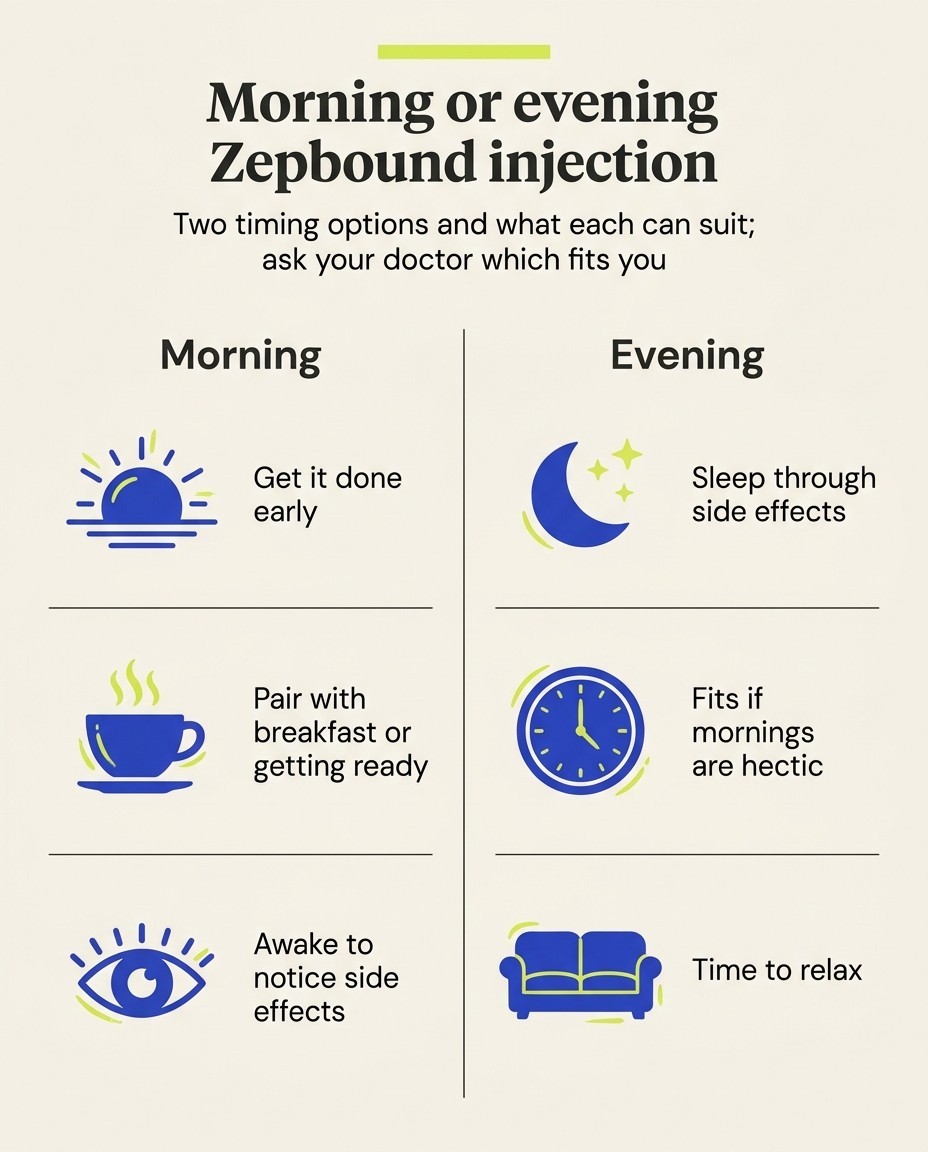
Morning injections:

Evening injections:
-
You might sleep through side effects like nausea.
-
Fits better if mornings are hectic.
-
Gives you time to relax.
-
Handy if you want privacy.
Some people switch between morning and evening, as long as it’s the same day each week. That’s totally fine.
If you’re just starting Zepbound, try your first shot on a day when you’re home. That way, you can see how you feel without extra stress.
Tailoring your Zepbound timing to your lifestyle
Finding the right schedule isn’t just about picking a day. It’s about making Zepbound fit your routines, your meals, and your memory.
Matching injection timing to weekly plans
The best time to inject is the day you can stick with every week. There’s no “perfect” day.
Some like Monday mornings for a fresh start. Others go for Friday evenings to ride out side effects over the weekend. Weekend injectors often pick Saturday or Sunday for more downtime.
The key is picking a day that’s easy to remember. If your week is unpredictable, choose a day when you’re usually home with a few minutes to spare. Recurring calendar reminders help a lot.
Your injection schedule shouldn’t stress you out. It should just fit in.
Meal timing and Zepbound injections
You can inject Zepbound with or without food. Meal timing doesn’t matter for the shot.
No need to wait for an empty stomach or rush to eat first. Inject whenever works for you.
Some people notice different side effects depending on meals. If you inject on an empty stomach and eat a big meal right after, nausea might be worse. Others feel better injecting after breakfast.
Pay attention the first few weeks and adjust if you need to. Planning your meals around what feels best for you can make a real difference to how you experience side effects.
Tips for remembering your dose
Missing doses can throw things off, so build reminders into your routine.
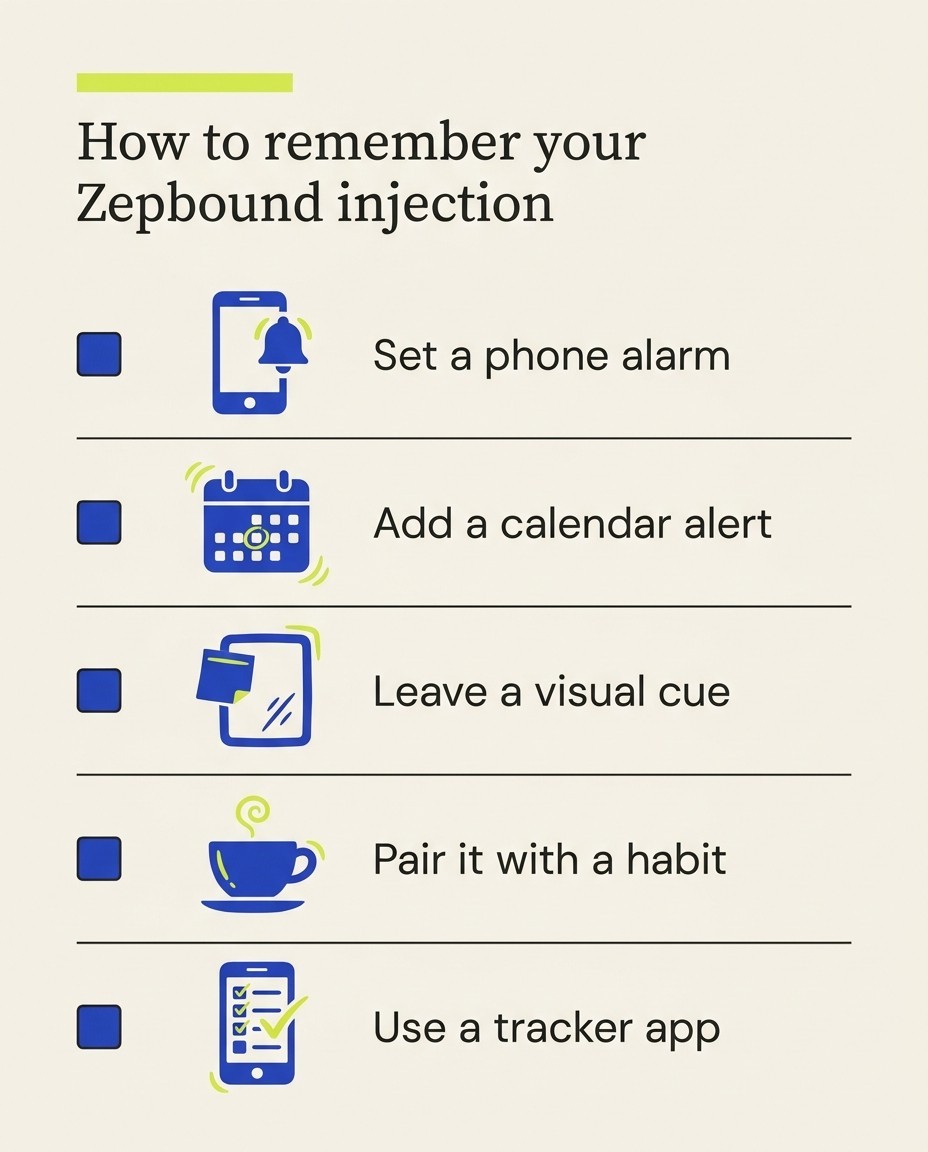
Set reminders:
Visual cues help:
-
Keep your Zepbound pen somewhere obvious
-
Stick a note on your mirror
-
Use a medication tracker app
Pair it with habits:
-
Inject after your Saturday coffee
-
Do it before meal prep
-
Pair with Sunday night TV
If you miss a dose, inject within four days if you can. If it’s been longer, just skip and stick to your regular day.
Keeping your schedule steady helps Zepbound work its best. But don’t worry if you slip up once in a while.
Important note for contraceptive users: If you take an oral contraceptive (the pill), be aware that Zepbound may reduce its effectiveness. Use additional barrier contraception (such as condoms) for 4 weeks after starting treatment and for 4 weeks after each dose increase.
Managing side effects by adjusting injection time
Changing your injection time can really affect how you feel. The timing shapes when side effects hit, so you can plan around work, sleep, or whatever’s on your plate.

Nausea and vomiting: choosing the right time
Many people find nausea is worst in the first day or two after a shot. If you inject in the morning and feel queasy all day, that’s a sign to try something different.
A lot of people switch to evening injections so they can sleep through the worst of it. When you wake up, the nausea often has faded.
If mornings work better, try injecting after a light meal. An empty stomach can make nausea and vomiting worse. Staying well hydrated helps too: aim for at least 68 ounces (about 2 liters) of water daily, or 68–100 ounces (about 2–3 liters) if you’re experiencing digestive side effects like nausea or bloating. For a baseline, the National Academies’ adequate total water intake is about 91 ounces a day for women and 125 ounces for men, counting water from food and all other drinks.
Most side effects improve within 2–4 weeks as your body adjusts to each dose. Nausea typically peaks during dose escalation and settles on a stable dose. Many people also find weekend injections helpful for extra rest time.
There’s no universal answer here. Just experiment and see what works for you.
Fatigue, energy levels and daily impact
Fatigue sometimes sneaks up after a Zepbound shot. You might feel tired, foggy, or just off for a day or two.
If you inject Monday morning and feel wiped out at work, try Friday night instead. That way, any tiredness lands on the weekend.
Some people get the worst fatigue in the first 12 to 24 hours. If that’s you, plan your shot for a day with fewer demands.
Try jotting down when you inject and how you feel. Patterns pop up fast, and you can tweak your timing.
Evening dosing for side-effect management
If nausea, diarrhea, or fatigue bother you, a bedtime injection means you’re less likely to notice. By morning, the worst is usually over.
It’s also just easier to do at home when you’re relaxed and not rushing.
A few evening dosing tips:
Lots of people who moved their shot to the evening noticed a real difference. But if it doesn’t work for you, that’s fine. The goal is to make Zepbound fit your life.
How Zepbound works and treatment considerations
Zepbound targets two hormone pathways, not just one. This makes it different from other weight loss injections. The dual action changes how your body handles blood sugar and appetite, and it often brings results faster than some other options.
Mechanism of action: GLP-1 and GIP
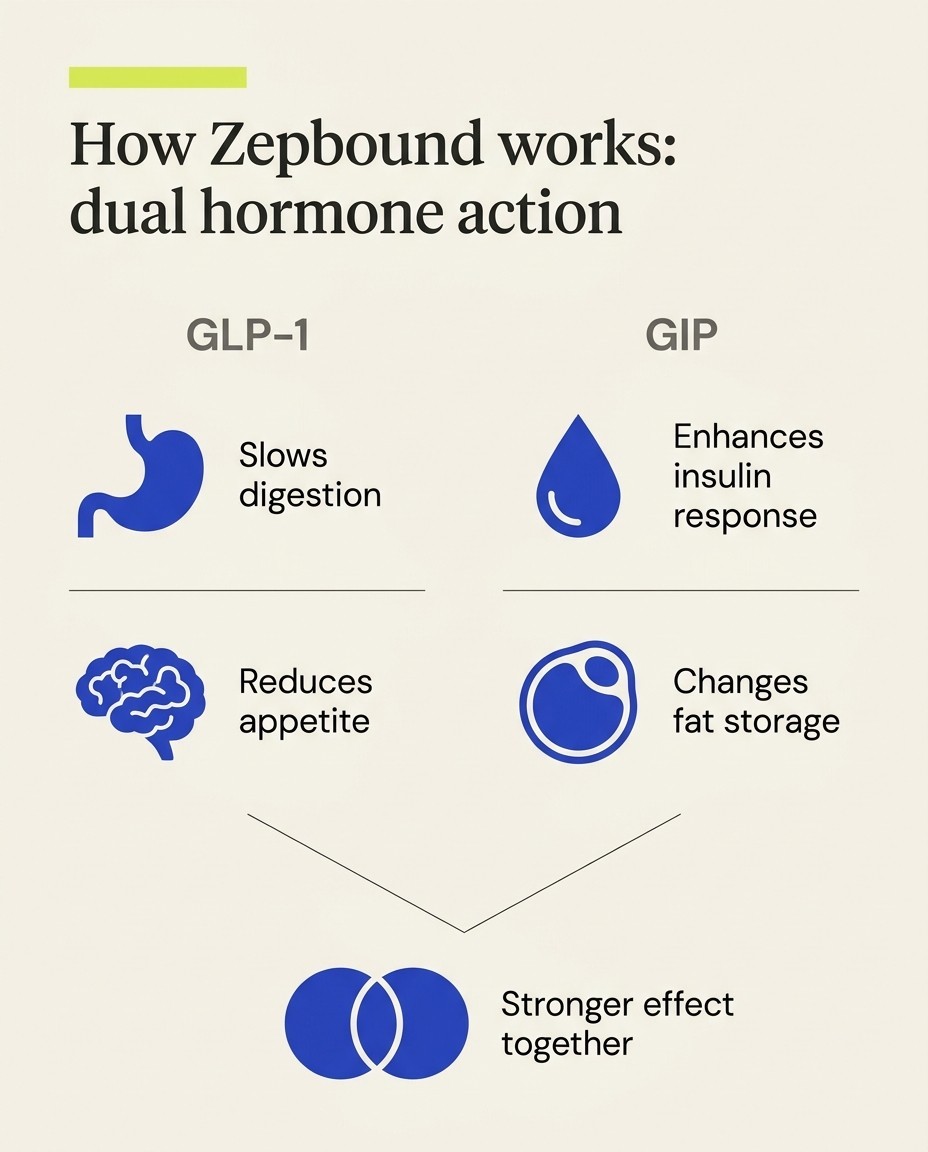
How Zepbound works is pretty straightforward once you get it. Tirzepatide (the active ingredient in Zepbound) is a dual GLP-1 and GIP receptor agonist, meaning it works on two appetite-regulating hormones instead of one. GLP-1 stands for glucagon-like peptide-1, and GIP stands for glucose-dependent insulinotropic polypeptide (Zepbound Prescribing Information).
GLP-1 slows how quickly food leaves your stomach, helping you feel full longer. It also tells your brain you’re full, so you eat less. This hormone helps your pancreas release insulin after meals.
GIP teams up with GLP-1 to boost insulin response. It also changes how your body stores fat and uses energy. Together, they pack a stronger punch than GLP-1 alone.
Most people feel full sooner and stay satisfied longer. Blood sugar control gets easier, and these effects help with weight loss and overall health markers like cholesterol and blood pressure.
Zepbound for weight loss versus Mounjaro for type 2 diabetes
Tirzepatide started as a type 2 diabetes treatment (Mounjaro) and was later approved for weight loss in certain cases, under the brand name Zepbound. How you use it depends on why you’re taking it, though the benefits often overlap.
For type 2 diabetes, the focus is blood sugar. You start low and increase the dose as needed. Weight loss often comes along for the ride.
For weight loss, the goal shifts to losing weight and improving related health markers like blood sugar, cholesterol, and blood pressure. You’ll start on 2.5mg once weekly for 4 weeks, with dose increases every 4 weeks up to a maximum of 15mg, depending on your response and how well you tolerate each step. Your prescriber tracks weight instead of just blood sugar.
Comparison with other weight loss injections
Zepbound isn’t the only option out there. Knowing how it stacks up against the others can help you decide what feels right.
Wegovy and Ozempic both use semaglutide, which targets just the GLP-1 pathway. In clinical trials, tirzepatide (Zepbound) showed average body weight loss of about 15–21% over 72 weeks across the 5mg to 15mg doses, with 20.9% at the highest dose (15mg), compared to around 15% for Wegovy at its maximum dose in a separate trial (68 weeks). Individual results vary significantly (source: SURMOUNT-1 trial).
Wegovy is really just for weight management. Ozempic, on the other hand, gets prescribed for diabetes.
Zepbound is actually tirzepatide, the same ingredient that’s in Mounjaro, but marketed for weight loss instead of diabetes. It’s the same medication with different branding and a different approved use.
Medication
Active ingredient
Hormone pathways
Primary use
Mounjaro
Tirzepatide
GLP-1 + GIP
Type 2 diabetes
Zepbound
Tirzepatide
GLP-1 + GIP
Weight loss
Wegovy
Semaglutide
GLP-1 only
Weight loss
Ozempic
Semaglutide
GLP-1 only
Type 2 diabetes
Some people respond better to one than the other, so your prescriber can help you decide which to try first.
When to seek medical help
Most side effects from Zepbound are mild and improve as your body adjusts. However, some symptoms need prompt medical attention.

Seek immediate medical help (call 911) if you experience:
- Severe abdominal pain, especially if it radiates to your back (possible pancreatitis)
- Signs of a serious allergic reaction: swelling of your face, lips, or throat, difficulty breathing, severe rash
- Severe, persistent vomiting that won’t stop
- Confusion, fainting, or signs of very low blood sugar (if you also take insulin or sulfonylureas)

See your doctor or prescriber if you notice:
- Nausea or vomiting that doesn’t improve after 2–4 weeks on a stable dose
- Persistent diarrhea or constipation affecting your daily life
- A lump or swelling in your neck, hoarseness, or difficulty swallowing (thyroid warning signs)
- Pain in your upper right abdomen (possible gallbladder issues)
- Side effects that worsen after a dose increase rather than improving

These are usually normal and tend to improve within 2–4 weeks:
- Mild nausea after injecting, especially in the first few weeks
- Reduced appetite or feeling full quickly
- Mild tiredness or fatigue for 1–2 days after your injection
- Occasional loose stools or mild stomach discomfort
- Mild injection site reactions (redness, itching) that clear within a few days
The bottom line
There’s no perfect time to take Zepbound. What matters is picking a day and time you can stick with every week. If side effects like nausea or fatigue bother you, try adjusting whether you inject in the morning or evening. Keep a consistent routine, set reminders, and speak to your prescriber if you’re struggling with side effects or missed doses. The best injection schedule is the one that fits your life.
Frequently asked questions
Can I change the day I take Zepbound?
Yes, but do it gradually. If you want to switch from Wednesday to Saturday, for example, speak to your prescriber about the best way to transition. You should always leave at least 3 days between doses.
Should I take Zepbound before or after eating?
You can take Zepbound with or without food, as meal timing doesn’t affect how the medication works. However, if you notice nausea after injecting on an empty stomach, try having a light meal beforehand to see if that helps.
What should I do if I forget to take my Zepbound injection?
If it’s been fewer than 4 days since your missed dose, inject as soon as you remember. If more than 4 days have passed, skip the missed dose and take your next one on your regular day. Don’t take two doses to make up for a missed one.
Is it better to take Zepbound at night to avoid side effects?
Many people find that injecting in the evening lets them sleep through side effects like nausea. However, this doesn’t work for everyone, as some people experience restlessness or insomnia. Try both and see what suits you best.
How long do Zepbound side effects last after each injection?
Side effects like nausea and tiredness are usually most noticeable in the first 24–48 hours after injecting. Most side effects improve within 2–4 weeks as your body adjusts to each dose. If side effects persist or worsen, speak to your prescriber.
Can I take Zepbound at different times each week?
You should try to inject at roughly the same time each week, but it doesn’t need to be exact. What matters most is keeping to the same day. If you inject at 8am one week and 8pm the next, that’s fine as long as it’s the same day.
Does Zepbound work faster if I take it at a certain time?
No. Tirzepatide is absorbed and works at the same rate regardless of when you inject. Timing your injection is about managing side effects and building a consistent routine, not about changing how quickly the medication works.
This article is for informational purposes only and does not replace professional medical advice. Zepbound is a prescription medication, so speak to your doctor or prescriber before starting, stopping, or changing your treatment. If you experience severe or persistent side effects, seek medical attention.
Sources
Sources
-
Jastreboff AM, et al. Tirzepatide Once Weekly for the Treatment of Obesity. N Engl J Med. 2022;387(3)
. https://www.nejm.org/doi/full/10.1056/NEJMoa2206038 -
Wilding JPH, et al. Once-Weekly Semaglutide in Adults with Overweight or Obesity. N Engl J Med. 2021;384(11)
. https://www.nejm.org/doi/full/10.1056/NEJMoa2032183 -
Zepbound (tirzepatide) Prescribing Information. U.S. Food and Drug Administration label, via DailyMed. https://dailymed.nlm.nih.gov/dailymed/drugInfo.cfm?setid=487cd7e7-434c-4925-99fa-aa80b1cc776b
-
Zepbound (tirzepatide) Medication Guide. DailyMed. https://dailymed.nlm.nih.gov/dailymed/medguide.cfm?setid=487cd7e7-434c-4925-99fa-aa80b1cc776b
-
Daily Water Intake Among U.S. Men and Women, 2009–2012. NCHS Data Brief No. 242. Centers for Disease Control and Prevention. https://www.cdc.gov/nchs/products/databriefs/db242.htm