
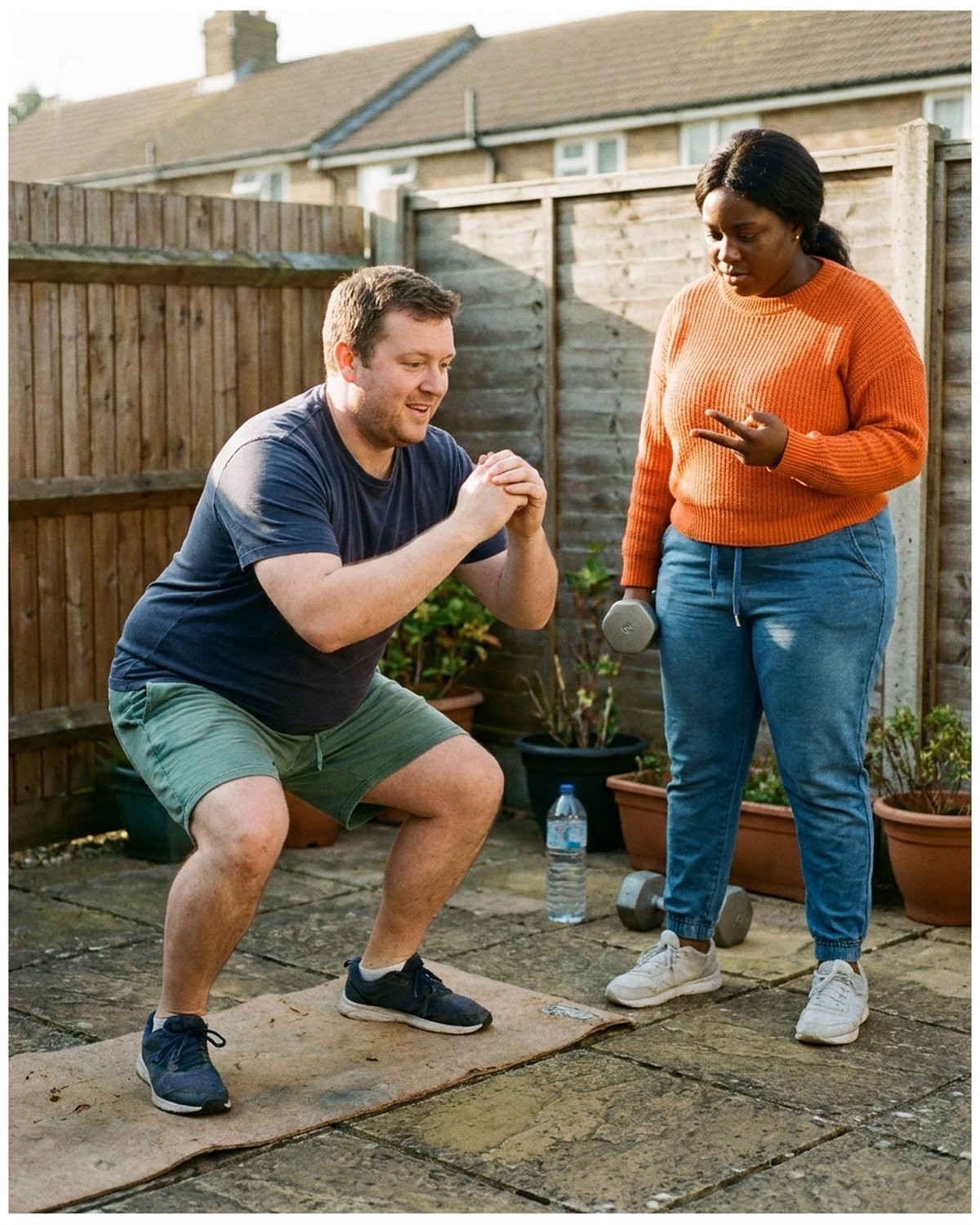
Walking into a gym, or clearing a space between the couch and the coffee table, for your first workout can feel confusing when everyone online seems to have a different opinion. Strength training for beginners is simpler than it looks. You can start with two or three short full-body sessions a week, using bodyweight exercises or light weights, and add more challenge only when each movement feels controlled.
The CDC guidelines recommend muscle-strengthening activity at least two days a week for adults. Researchers usually count anyone with less than about two months of training as a beginner (this review), so being brand new is completely normal.
This guide covers what strength training does for you, why it matters while you’re losing weight, a simple first routine with home and gym options, and how to progress safely while giving yourself time to recover.
Key takeaways

What strength training does for you
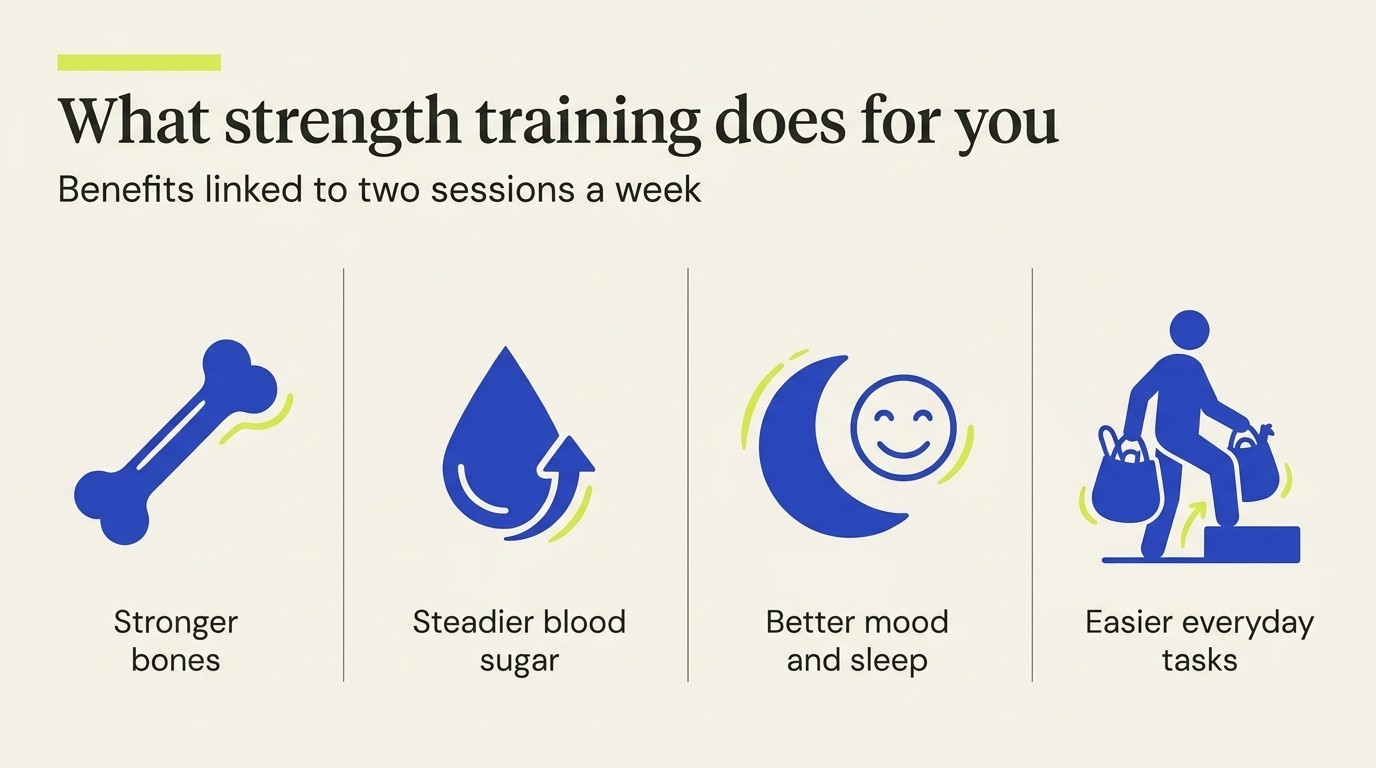
Strength training does more than build muscle mass and strength. Established benefits include:
- Bone density: Loading your bones through resistance training can help maintain or improve bone density (NIH), which matters for healthy aging.
- Metabolic health: Regular resistance training is linked to better insulin sensitivity, meaning your body uses insulin more effectively to move sugar out of your blood and into your muscles, and to better blood sugar control (this review).
- Heart health: Adults who do muscle-strengthening activity regularly have a lower risk of heart disease, type 2 diabetes and early death than those who don’t, according to a large review of observational studies. The biggest benefit showed up at around 30 to 60 minutes a week, which is about two beginner sessions.
- Resting energy use: Muscle uses a little more energy at rest than fat does, so building and keeping it supports your metabolism over time. The effect is modest, but it adds up, especially while you’re losing weight.
- Mental health: Many people report better mood and sleep with regular exercise (MedlinePlus).
- Functional strength: Stronger muscles make everyday movement easier, such as climbing stairs or carrying groceries.
Even a short beginner program can make a difference: in one review, adults who strength trained for about 10 weeks added lean weight and lost body fat.
Strength training while you’re losing weight
When you lose weight, some of what you lose is muscle, not just fat. That happens with any approach, including eating fewer calories on your own and taking a GLP-1 medication. In the STEP 1 trial of semaglutide, a substantial share of the weight people lost was lean mass.
Strength training two or three times a week, along with enough protein, is the most reliable way to hold on to more of that muscle. It won’t burn a huge number of calories in the session itself, so don’t judge it as a fat-burning workout. Its job is to protect your strength, your balance and your metabolism while the number on the scale changes.
Your first full-body routine
A first routine can be two full-body sessions per week built on a squat, a hip hinge, a push, a pull and a carry, using whatever equipment you have. Start with light loads and controlled reps, and add weight gradually.
Start with two days a week
Many adults benefit from strength training two to three times per week, and two full-body sessions a week is enough for beginners to get stronger (ACSM).
Leave at least one rest day between sessions, such as Monday and Thursday or Tuesday and Saturday. This gives your muscles time to recover. Once two days feels manageable, you can move to a simple full-body routine two or three times per week.
Setup
Good for

Things to know
Sets, reps and starting weights
A rep is one full movement. A set is a group of reps done back to back.
A practical beginner structure:
- Sets and reps: 2 sets of 8–12 reps per exercise
- Rest periods: 60–90 seconds between sets
- Starting weight: a load where you could do 2–3 more reps with good form when you stop (often called “reps in the tank”)
Your first session should feel easier than you expect. Going all-out on day one is the most common way beginners end up too sore to come back.
Work in the higher rep ranges until your technique is consistent. Many beginners add weight too quickly, so increase the load only after you complete all reps with control for two sessions in a row.
Warming up and moving with control
Spend 5–10 minutes warming up. Walk briskly or march in place, then do one light set of each exercise you plan to train.
Move slowly, taking about 2–3 seconds to lower each rep. Aim for the fullest range of motion you can control without pain. A full range of motion looks different for every body, and a shorter, comfortable range is a fine starting point that you can extend over time.
Learning the squat and hip hinge
The squat and hip hinge are compound movements, meaning they work several joints and muscle groups at once. Together they train your legs, glutes and back.
A hip hinge means bending forward from your hips while keeping your back long and your knees softly bent, the same movement you use to close a car door with your hips or pick a bag up off the floor.
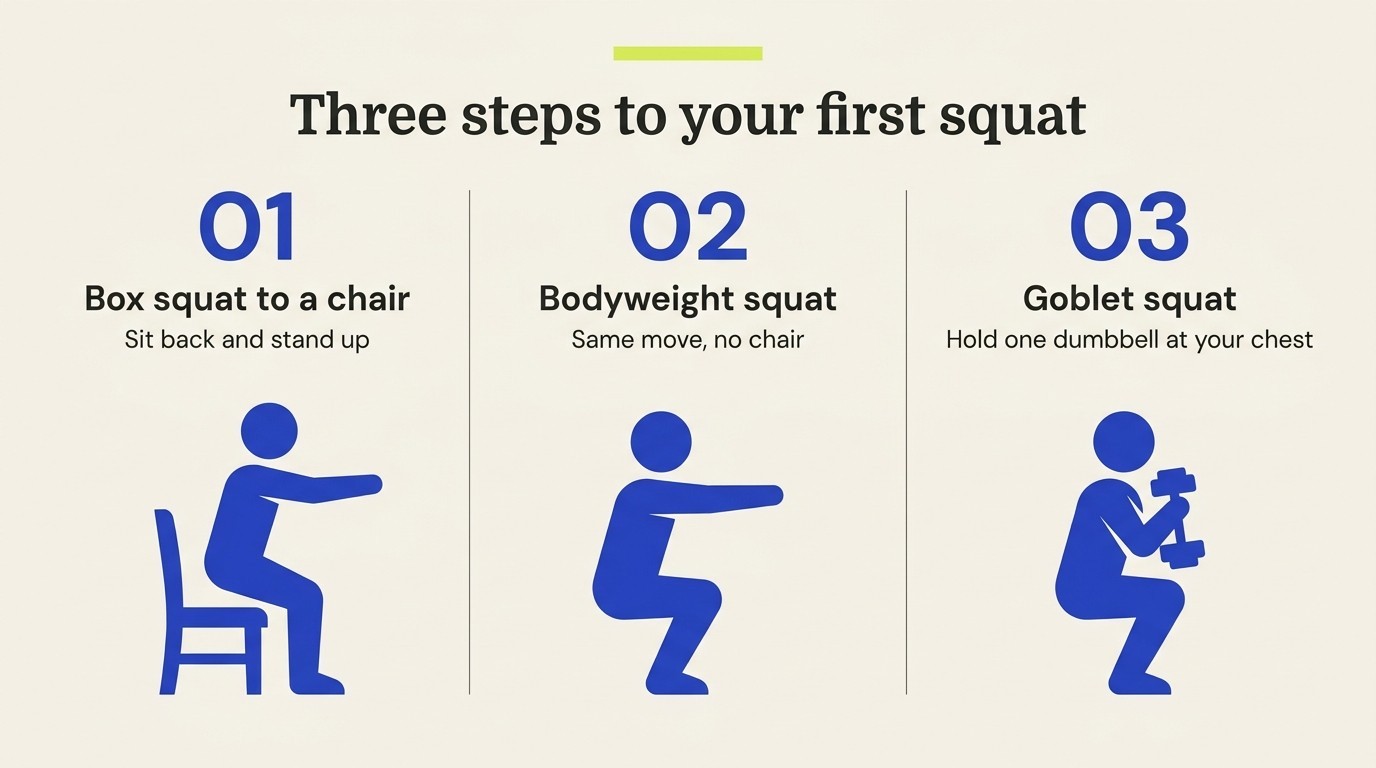
Squat progressions:
- Box squat to a chair
- Bodyweight squat
- Goblet squat holding one dumbbell or kettlebell
Hinge progressions:
- Hip hinge with a dowel along your back
- Glute bridge
- Dumbbell Romanian deadlift
The Romanian deadlift starts from a standing position rather than from the floor, which makes it easier to learn than a conventional deadlift. For the first few weeks, you’re practicing, not testing yourself.
Pushing and pulling moves
Pushing and pulling exercises balance your upper body.
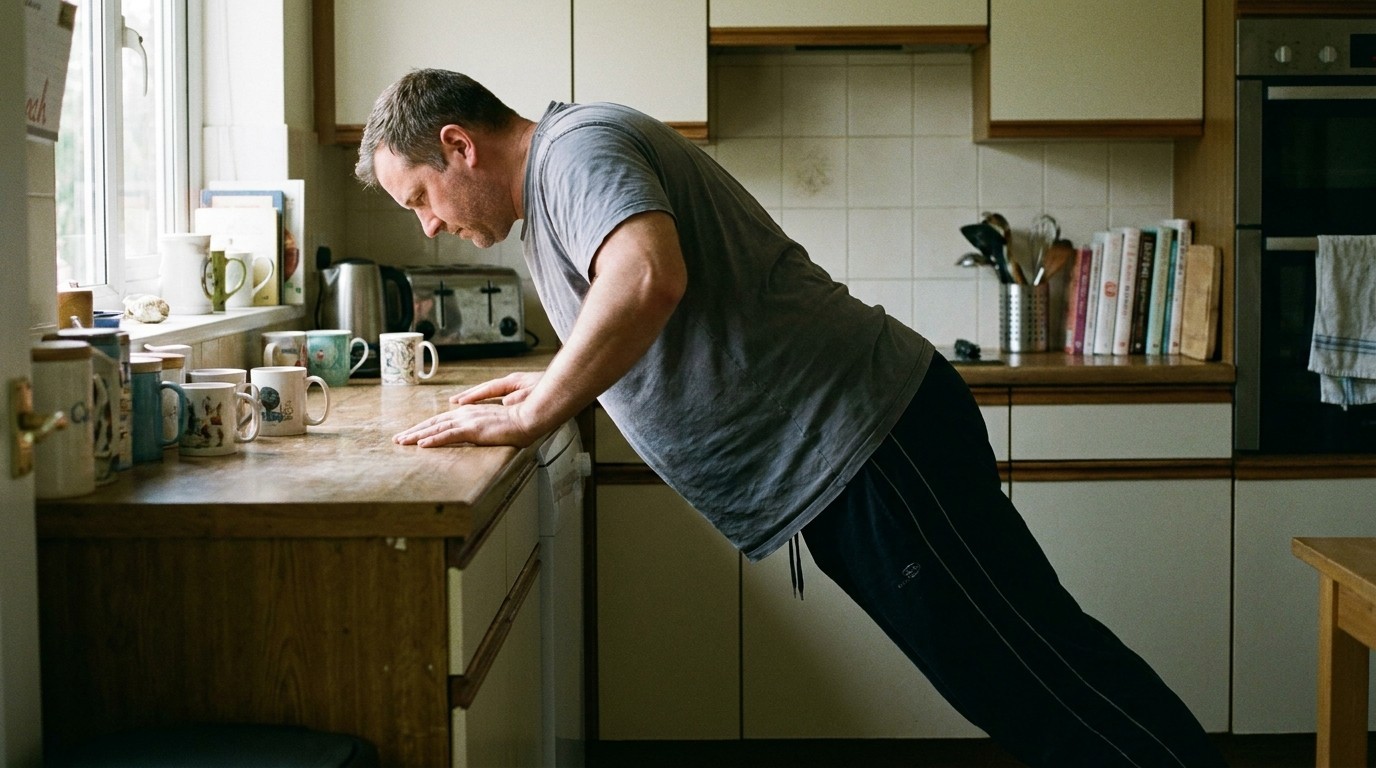
- Push-up: Start against a wall, then a kitchen counter, then a sturdy bench. Lower the height as you get stronger.
- Dumbbell chest press: Lie on a bench or the floor. This is a common lead-in to the barbell bench press.
- Rows: Try a band row, a dumbbell row with one hand on a bench, or a seated cable row machine.
- Overhead press: A seated dumbbell shoulder press gives you back support while you learn.
Do roughly as many pulling sets as pushing sets each week.
A simple two-day workout
Many coaches use an A/B split that alternates between two full-body sessions. Do 2 sets of 8–12 reps for each exercise. For carries, walk for 20 to 30 seconds per set.
| Movement | Day A: Home | Day A: Gym | Day B: Home | Day B: Gym |
|---|---|---|---|---|
| Squat | Chair box squat | Leg press machine | Goblet squat | Goblet squat |
| Hinge | Glute bridge | Dumbbell Romanian deadlift | Band Romanian deadlift | Back extension machine |
| Push | Incline push-up | Dumbbell chest press | Band chest press | Chest press machine |
| Pull | Band row | Seated cable row | Dumbbell row | Lat pulldown |
| Press | Band overhead press | Dumbbell shoulder press | Dumbbell shoulder press | Shoulder press machine |
| Carry | Farmer’s carry with two grocery bags | Dumbbell farmer’s carry | Farmer’s carry with two grocery bags | Kettlebell farmer’s carry |
A reasonable first milestone is completing two or three full-body sessions a week consistently for several weeks.
When to stop or modify an exercise
Stop the exercise if you feel sharp pain, joint pain, dizziness, chest pain, or unusual shortness of breath. Mild muscle soreness for a day or two after training is common. Pain during a movement is not something to push through.

When to call 911
Call 911 if you have chest pain, pressure or tightness, pain spreading to your arm, jaw or back, fainting, or shortness of breath that doesn’t settle with rest.
To modify an exercise, you can:
- Reduce the weight or band tension
- Shorten the range of motion
- Switch to a supported version, such as a machine or an incline push-up
Talk with your doctor before starting if you have a heart condition, high blood pressure that isn’t under control, recent surgery, a joint injury, or another health condition that affects exercise, or if you’re pregnant. A certified personal trainer or physical therapist can also check your form in person.
Making steady progress
Your strength grows when you add small, regular challenges to your workouts and give your body enough rest, sleep, and food to adapt. Tracking your sessions, knowing which aches are normal, and adjusting when progress stalls will keep you moving forward safely.
Add reps before weight
Progressive overload means slowly asking your muscles to do a bit more over time. The ACSM position stand describes progression as adjusting training gradually so you keep improving without overdoing it.
For beginners, the simplest method is a “double progression” approach:
- Pick a rep range, such as 8 to 12 reps.
- Start with a weight you can lift for 8 reps with good form.
- Add a rep or two each session until you reach 12 on every set.
- Then increase the weight by the smallest step available and start again near 8 reps.
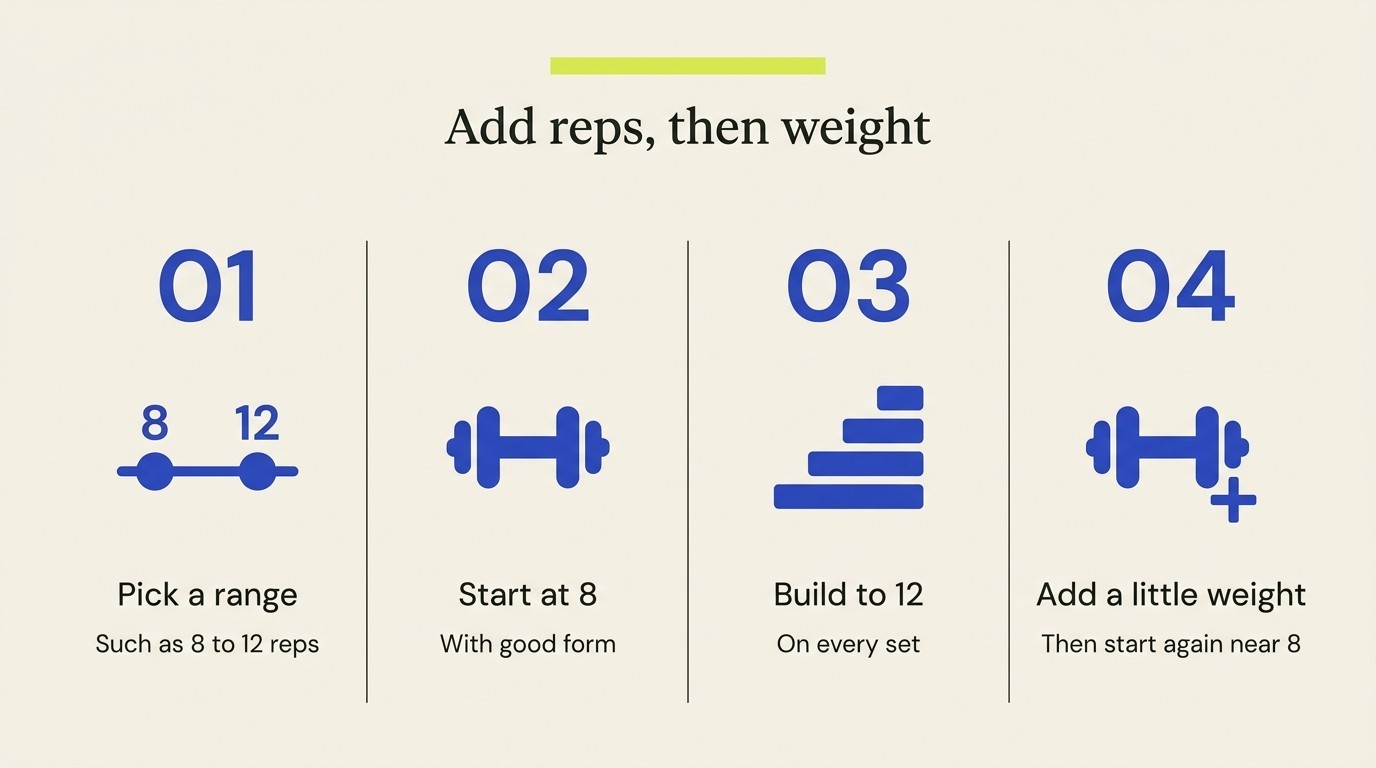
This keeps form solid and lowers your injury risk. Adding reps first also builds confidence before the load goes up.
Tracking your progress
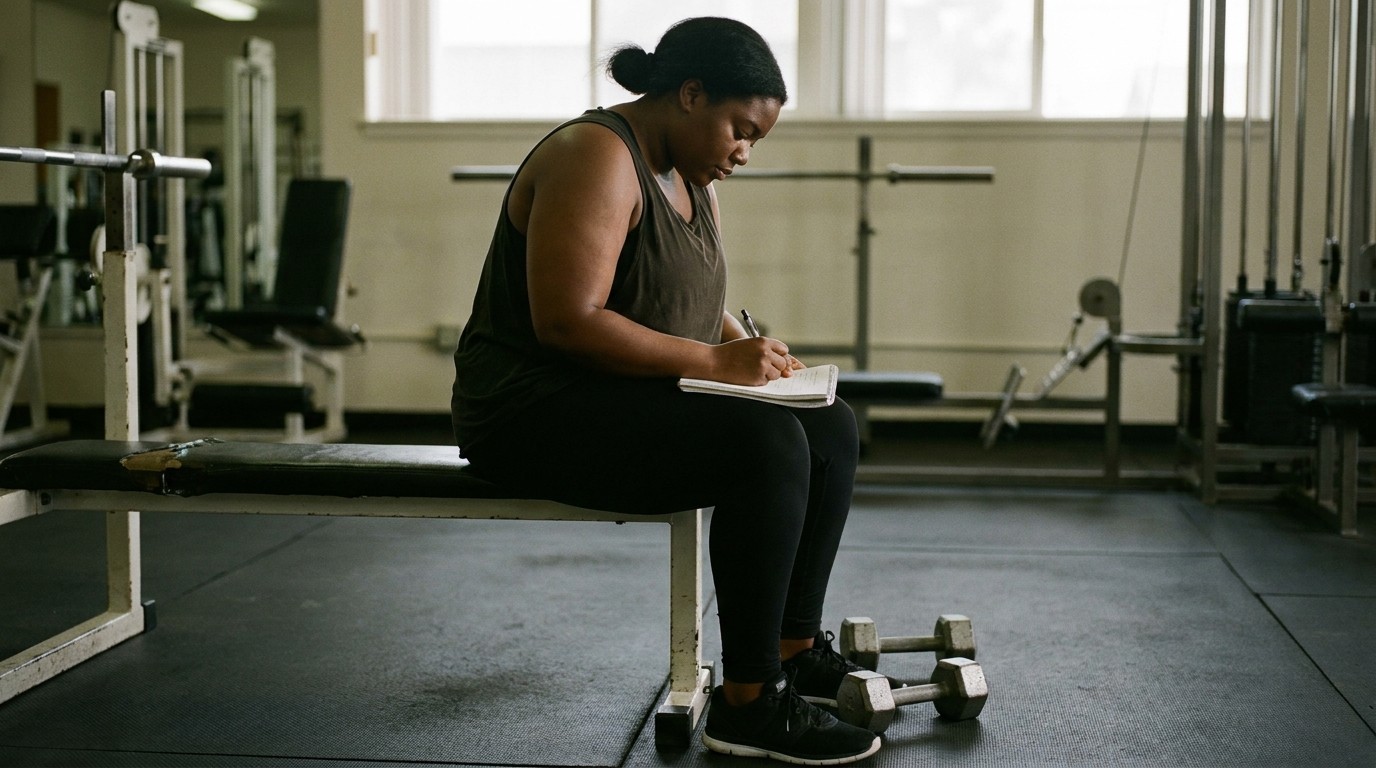
A simple log helps you see progress you might otherwise miss. Write down the date, exercise, weight, sets, reps, and how hard each set felt on a scale of 1 to 10.
Beginners usually gain strength quickly at first, and the rate of gains slows as you become more experienced (training research).
Much of that early improvement comes from your nervous system learning the movements. In practice, that means you may lift noticeably more within a few weeks, even before your muscles look any different. Visible muscle growth, or hypertrophy, tends to take longer, often several weeks to months. Expect progress to slow over time; that is normal.
Normal soreness vs. warning signs
Delayed onset muscle soreness (DOMS) often shows up 24 to 72 hours after a new or harder workout. It usually fades within a few days and becomes milder as your body adapts.
| Usually normal | Stop and get checked |
|---|---|
| Dull, achy tightness in worked muscles | Sharp or stabbing pain during a lift |
| Soreness in the muscles you trained, on both sides | Pain in a joint rather than a muscle |
| Improves with light movement | Swelling, bruising, or numbness |
| Fades within a few days | Very dark urine or extreme weakness |
Very dark, cola-colored urine with severe muscle pain or weakness a day or two after a hard workout can be a sign of rhabdomyolysis, a rare but serious muscle breakdown. Get medical care the same day.
Light activity such as walking and gentle stretching may help you feel less stiff.
Rest, sleep and food
Training is the signal to get stronger; rest and recovery are when your body actually adapts.
- Rest days: Leave at least one day between sessions that train the same muscles.
- Sleep: The CDC recommends at least 7 hours per night for adults.
- Protein: Aim for roughly 25–30 grams of protein at each meal, such as a cup of Greek yogurt, a chicken breast or a block of tofu, rather than saving most of it for dinner. Spreading protein across your meals gives your muscles a steady supply of the building blocks they use to repair and grow after training. Your needs depend on your size, age and goals, so a registered dietitian can give you a personal target.
- Enough food: Your muscles need energy to recover. If you’re cutting calories to lose weight, a moderate deficit with plenty of protein lets you keep getting stronger; eating far too little can stall your progress in the gym and make sessions feel much harder.
Stress and sleep outside the gym also affect how well you recover. If you take a medication that lowers your appetite, talk with your doctor or a registered dietitian about meeting your protein needs.
Plateaus and deload weeks
A plateau is when your lifts stop improving for two or three weeks in a row. First, check the basics: sleep, food intake, stress, and whether you are using consistent form.
If those look fine, try small changes:
- Switch to a slightly different rep range, such as 6 to 8.
- Add one extra set to a key exercise.
- Swap in a similar movement, like goblet squats for leg presses.
A deload week is a planned easier week that gives your body a chance to recover before you push on. You might cut your sets or weights by about half for one week, often after 6 to 8 weeks of steady training.
Adding optional exercises
Your plan should center on a few basic movements. Once these feel steady, you can add one or two optional exercises.
The lateral raise is a good example. It targets the side of your shoulders and works well with light dumbbells or a resistance band. Start with 2 sets of 12 to 15 reps using a weight you can control without swinging.
Keep extras to the end of your workout so they do not tire you out before your main lifts. If you want guidance on form, a beginner class at a local gym or community center lets you try exercises with an instructor present.
Frequently asked questions
How should a complete beginner start strength training?
Start with a few basic movement patterns and practice them with little or no weight. Learning how each exercise should feel comes first, before you focus on heavier loads.
If you have a health condition, an injury, or you haven’t exercised in a long time, talk with your doctor before you begin. Small, gradual changes work best, which matches the federal guidelines on adding modest amounts of activity at a time.
Will strength training help me lose weight?
On its own, a strength session burns fewer calories than you might hope, and the scale may barely move at first. Its real value is what it does alongside eating changes: it helps you keep muscle while you lose fat. Many people notice their clothes fit differently before the number changes. See “Strength training while you’re losing weight” above for more.
What are the five basic strength training exercises for beginners?
These five movements cover most of your major muscle groups:
- Squat (bodyweight, goblet, or box squat) for your legs and hips
- Hip hinge (Romanian deadlift or glute bridge) for your hamstrings, glutes, and back
- Push (wall, incline, or floor push-up) for your chest, shoulders, and triceps
- Pull (dumbbell row or band row) for your upper back and biceps
- Carry (farmer’s carry: walk for 20 to 30 seconds holding a dumbbell, kettlebell or heavy grocery bag in each hand) for your grip and core
Classic novice programs such as Starting Strength build on similar compound lifts because each one trains several muscles at once.
What is a good weekly strength training plan for beginners?
The CDC recommends that adults do muscle-strengthening activities that work all major muscle groups at least two days per week. A simple setup is two or three full-body workouts on nonconsecutive days, such as Monday, Wednesday, and Friday. Alternate the A and B workouts from the routine above.
| Day | Activity |
|---|---|
| Monday | Workout A |
| Tuesday | Walking or rest |
| Wednesday | Workout B |
| Thursday | Walking or rest |
| Friday | Workout A (optional third day) |
| Weekend | Light activity or rest |
The following week, start with Workout B so both sessions get equal time.
How can beginners start strength training at home with little or no equipment?
Your body weight is enough to start. Simple bodyweight exercises like squats to a chair, glute bridges and incline push-ups against a kitchen counter cover most of your major muscles, and a resistance band anchored in a door handle handles rows.
A pair of adjustable dumbbells or a set of bands gives you more room to progress later. Until then, make bodyweight moves harder by taking three seconds to lower each rep or adding a short pause at the bottom.
What is a good beginner strength training routine for women?
Women can follow the same full-body routine as anyone else. Women and men gain strength at similar relative rates when they follow the same program (ACSM), so the routine above works for anyone.
A common concern is getting “bulky.” Building large amounts of muscle takes years of focused training and eating, so a few sessions a week will mostly make you stronger. If you’re pregnant or postpartum, ask your doctor which changes make sense for you. ACOG also has guidance on exercise during pregnancy.
How do I choose the right weights, sets, and reps when starting strength training?
Pick a weight you can lift for 8 to 12 reps with good form, where the last two reps feel challenging but doable. Start with 2 sets per exercise (1 is fine for your first week or two) and rest 60 to 90 seconds between sets.
Research on novice loads supports starting lighter than experienced lifters train. Once you can do all your sets at the top of your rep range, add a small amount of weight, such as 2.5 to 5 pounds, and work back up.
How long does it take to see results?
Most beginners notice they can lift more within two to four weeks, mostly because their nervous system is learning the movements. Visible changes in muscle usually take two to three months of consistent training. See “Tracking your progress” above for more.
Should I do cardio or strength first?
If strength is your priority, lift first while you’re fresh, then walk or cycle afterward. On separate days, the order doesn’t matter. Federal guidelines recommend doing both each week.