

There’s no official Zepbound clicks chart. The Zepbound KwikPen’s instructions say plainly: “Do not count clicks as you select the dose.” You turn the dose knob until it stops, and the pen sets your full prescribed dose for you. The click charts shared online are a workaround some people use to take smaller or “in-between” doses, and the FDA label doesn’t support them.
Zepbound (tirzepatide) is FDA-approved for chronic weight management in adults with obesity, or overweight with at least one weight-related health condition, and for moderate-to-severe obstructive sleep apnea in adults with obesity. Since early 2026 it has also come in a multi-dose KwikPen, which is where the clicks question comes from. This guide explains how the KwikPen actually works, why people count clicks, and what to do instead if your dose isn’t working for you.

The Zepbound KwikPen holds four fixed weekly doses. To set a dose, you turn the knob until it stops and the dose icon shows in the window. The FDA-approved instructions say not to count clicks. Click charts online are unofficial and are meant for taking partial doses, which the label doesn’t support. If you need a slower dose increase, ask your prescriber.
Key takeaways

What is the Zepbound clicks chart?
A “clicks chart” is an unofficial table that claims to match a number of clicks on the KwikPen’s dose knob to an amount of tirzepatide. The idea started with the multi-dose tirzepatide pen sold in the UK and Europe, where some people counted clicks to dial less than a full dose. When the Zepbound KwikPen arrived in the US in 2026, the same charts started circulating in forums and social media groups.
People usually turn to them for one of three reasons:
-
Gentler dose increases: Moving up a dose can bring back nausea and other side effects. Some people want a step in between.
-
Making a pen last longer: Taking smaller doses stretches the medicine over more weeks.
-
Cost: Zepbound is expensive without insurance, and a pen that lasts longer looks cheaper.
Those reasons are understandable. But the KwikPen wasn’t built for partial doses, and nobody has checked how accurate a click-counted dose is.
How the Zepbound KwikPen works
The KwikPen is a single-patient-use pen that holds four weekly doses of one strength. Each pen strength delivers one of the standard Zepbound doses: 2.5 mg, 5 mg, 7.5 mg, 10 mg, 12.5 mg or 15 mg (Zepbound prescribing information).
Each week you:
-
Attach a new pen needle. Needles aren’t included, so you’ll need KwikPen-compatible pen needles from your pharmacy.
-
Prime the pen. The instructions say to prime before every weekly injection. Priming clears air from the cartridge and checks the pen is working: you should see a drop of medicine at the needle tip.
-
Select your dose by turning the dose knob until it stops and the dose icon shows in the dose window. The pen sets the full dose for you.
-
Inject into your stomach, thigh or the back of your upper arm, and hold the pen in place as the instructions describe.
The knob makes clicking sounds as it turns, which is why people started counting them. But the clicks aren’t a measuring scale. The pen is designed to stop at your full dose, and the instructions tell you not to count.
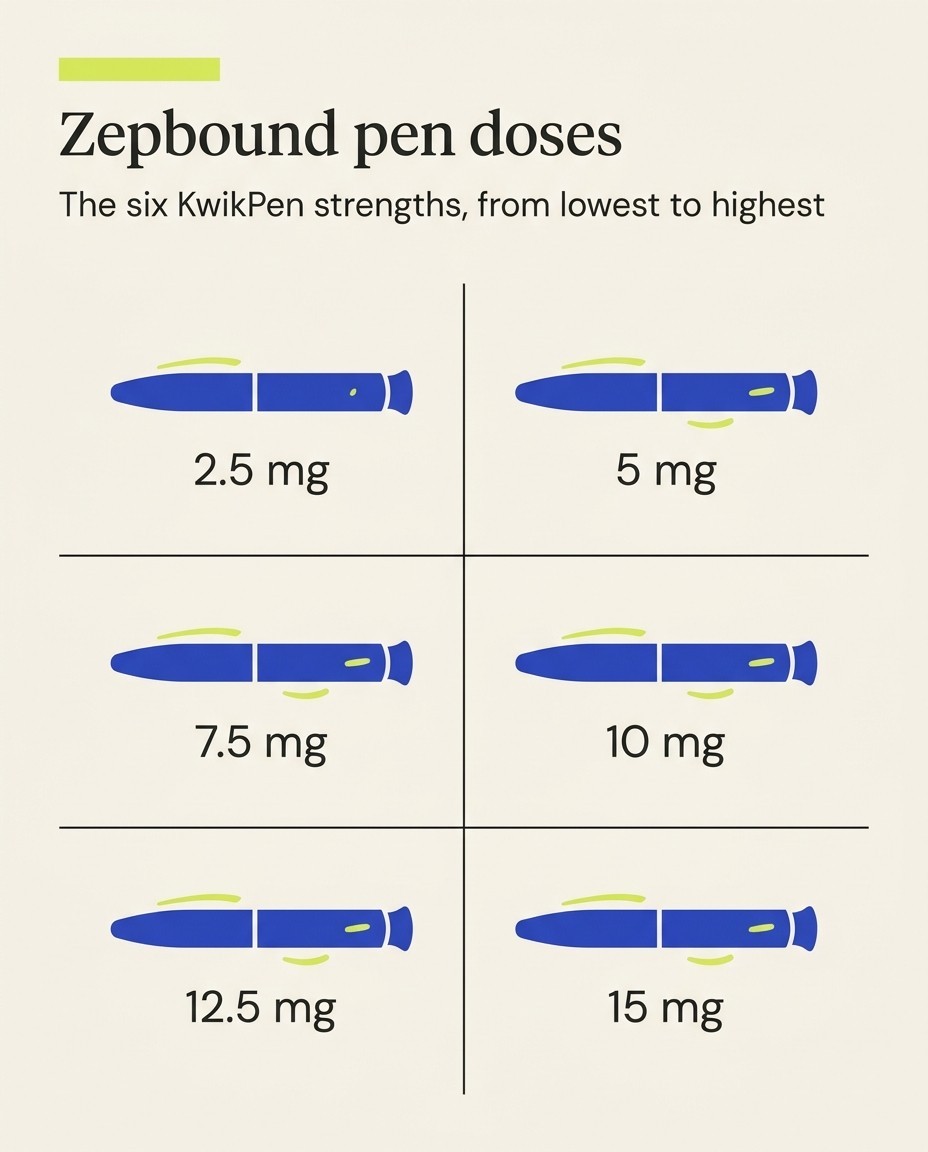
Zepbound comes in other forms too
The KwikPen is one of four ways to take Zepbound in the US:
-
Single-dose pen: an autoinjector with one fixed dose. You don’t set anything, and it’s thrown away after one use.
-
Single-dose vial: one dose, drawn up with a syringe.
-
Multi-dose vial: four weekly doses, drawn up with a syringe.
-
Single-patient-use KwikPen: four weekly doses, set with the dose knob.
Your prescription and your insurance or self-pay option decide which one you get. If you switch, read the instructions for the new form, because each one works differently.
Why counting clicks isn’t recommended
Using a clicks chart means taking Zepbound in a way that hasn’t been studied or approved. The main problems are:
-
Unknown accuracy: The pen is calibrated to deliver full doses. Nobody has tested how much medicine a partial turn of the knob delivers, so a counted dose could be more or less than you think.
-
Doses outside the studies: In the clinical trials, people took fixed doses on a set schedule (SURMOUNT-1). The results don’t tell us what happens on custom doses.
-
Harder for your prescriber to help: If you’re taking an unofficial dose, your prescriber can’t easily judge whether side effects or a weight plateau come from the dose, the medicine or something else.
-
Running past the pen’s limits: Opened pens have to be thrown away after four doses or 30 days, whichever comes first. Stretching a pen beyond that means using medicine past the period the label covers.
What about the leftover medicine?
After four doses you may see a little liquid left in the cartridge. That’s deliberate: each KwikPen contains extra volume so you can prime it before every dose (Zepbound prescribing information). It isn’t a fifth dose, and the instructions say to throw the pen away after four doses, including any medicine left inside. Don’t try to draw it out with a syringe. Our guide to the Zepbound “golden dose” explains this in more detail.
Zepbound doses, the official way
The official schedule already builds in gradual steps (Zepbound prescribing information):
| Stage | Weekly dose |
|---|---|
| Weeks 1 to 4 | 2.5 mg (starting dose, not a maintenance dose) |
| Weeks 5 to 8 | 5 mg |
| Further increases, if needed | 2.5 mg steps, at least 4 weeks apart |
| Maintenance | 5 mg, 10 mg or 15 mg |
| Maximum | 15 mg |
You don’t have to move up every four weeks. “At least 4 weeks” means your prescriber can keep you on a dose for longer if you’re still adjusting, which is the official answer to the problem click charts try to solve. See our full Zepbound dosage guide for more.
Using your KwikPen safely
Storage
-
Before first use: Keep pens in the fridge at 36°F to 46°F (2°C to 8°C). An unopened pen kept at room temperature has to be thrown away after 30 days.
-
After first use: Keep the pen in its carton, in the fridge or at room temperature up to 86°F (30°C).
-
When to throw it away: After four doses, 30 days after first use, or a total of 30 days at room temperature, whichever comes first, even if there’s medicine left.
-
Don’t freeze it: If a pen has been frozen, don’t use it.
These rules are for the KwikPen. Single-dose pens and vials can be kept at room temperature for up to 21 days in total. Our Zepbound storage guide covers every form.
Before each injection
-
Check the medicine is clear and colorless to slightly yellow, with no particles.
-
Use a new needle every time.
-
Rotate where you inject each week.
-
Never share your pen with anyone, even with a new needle.
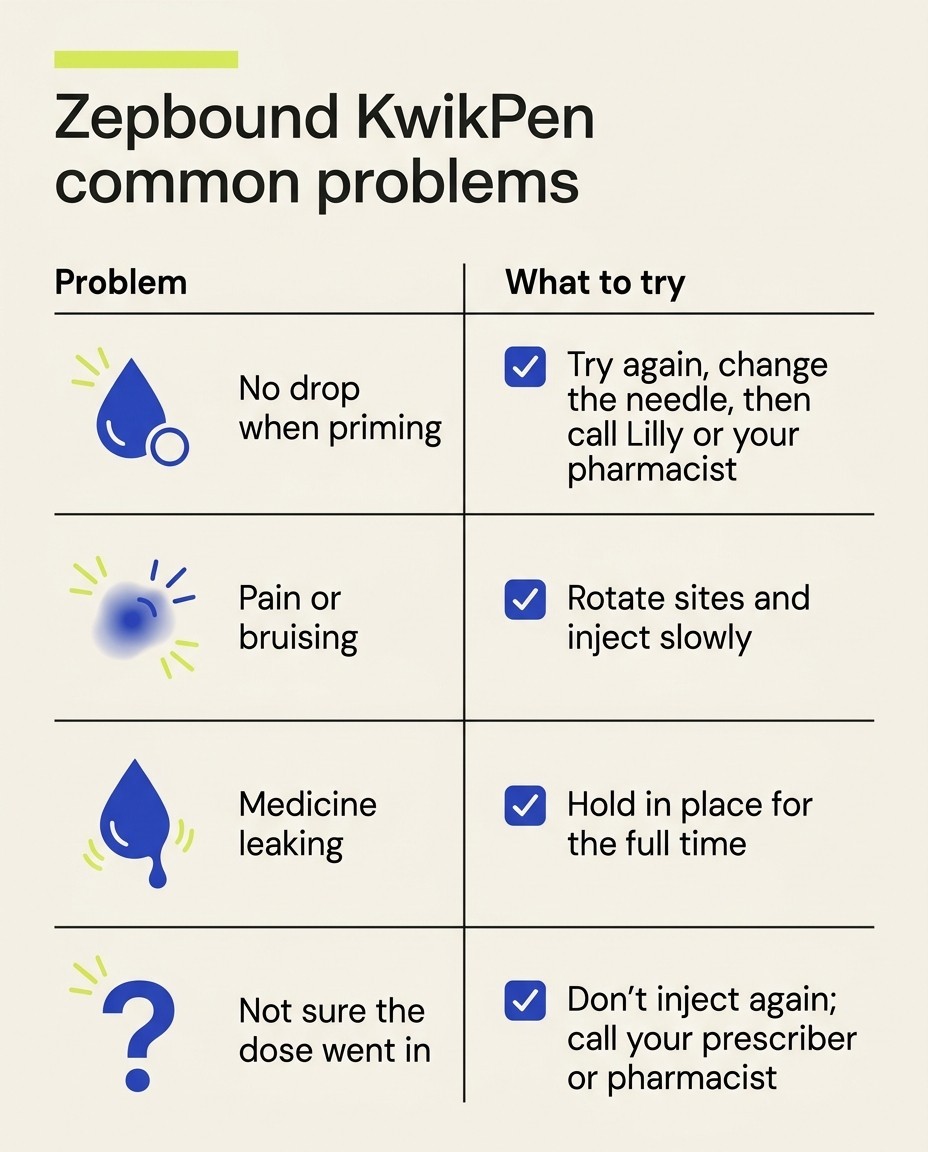
Common problems
-
No drop of medicine when priming: The instructions allow a few more tries and a needle change. If you still see no drop, don’t inject. Contact Lilly or your pharmacist.
-
Pain or bruising: Try a different site each week and inject slowly and steadily. If it keeps happening, ask your pharmacist to check your technique.
-
Medicine leaking from the skin: You may have removed the pen too soon. Next time, hold it in place for the full time in the instructions.
-
Not sure the dose went in: Don’t inject again. Doubling up can cause serious side effects. Call your prescriber or pharmacist for advice before your next dose.
Getting support from your healthcare provider
A good prescriber reviews your medical history and current medicines before you start, and checks in as your dose changes. Tell them about every other medicine you take. Zepbound can affect how some medicines are absorbed, including birth control pills, and your risk of low blood sugar is higher if you also take insulin or a sulfonylurea.
Zepbound isn’t suitable for everyone. Don’t use it if you or a family member has had medullary thyroid carcinoma, or if you have Multiple Endocrine Neoplasia syndrome type 2 (MEN 2). It isn’t recommended during pregnancy.

Get emergency help if you have:
- Severe stomach pain that won’t go away, with or without vomiting, sometimes spreading to your back (possible pancreatitis)
- Swelling of your face, lips, tongue or throat
- Trouble breathing or swallowing
- Signs of a severe allergic reaction
Call 911 if you think you’re having a severe allergic reaction or pancreatitis.

Contact your prescriber if you notice:
- Side effects lasting more than 2 to 4 weeks after a dose change
- Nausea, vomiting or diarrhea that makes it hard to eat or drink
- Lumps or swelling at injection sites
- Signs of low blood sugar (shakiness, dizziness, confusion), especially if you also take insulin or a sulfonylurea
- Anything that worries you or gets in the way of daily life
The bottom line
The Zepbound KwikPen is designed so you don’t have to count anything: turn the knob until it stops and you’ve set your full dose. The click charts online come from a workaround for taking partial doses, and the pen’s instructions say not to count clicks. If a dose increase is hard going, or cost is the reason you’re tempted, talk to your prescriber. Staying on a dose longer, or switching to a different form of Zepbound, are both options that keep you within the label.
Frequently asked questions
How many clicks is each Zepbound dose?
There’s no official number. The KwikPen instructions say not to count clicks: you turn the dose knob until it stops and the dose icon shows in the window, and the pen sets your full prescribed dose.
Can I use a clicks chart to take a smaller dose?
It isn’t recommended. The pen isn’t designed or tested for partial doses, so you can’t be sure how much you’re getting. If you need a gentler increase, your prescriber can keep you on your current dose for longer.
Do I need to prime my Zepbound KwikPen every time?
Yes. The instructions say to prime before each weekly injection. You should see a drop of medicine at the needle tip, which shows the pen is working.
Why is there medicine left in my KwikPen after four doses?
Each pen has extra volume for priming before every dose. It isn’t a spare dose. Throw the pen away after four doses, including any medicine left inside.
How long does an opened Zepbound KwikPen last?
Throw it away after four doses, 30 days after first use, or a total of 30 days at room temperature, whichever comes first.
What happens if I miss a dose of Zepbound?
If it’s been 4 days (96 hours) or less since your usual day, take it as soon as you can. If it’s been more than 4 days, skip that dose and take the next one on your usual day. Don’t take two doses to make up for a missed one.
Where can I find the official Zepbound instructions?
The Zepbound prescribing information, Medication Guide and Instructions for Use are on DailyMed, the National Library of Medicine’s drug label database. Each form of Zepbound has its own Instructions for Use. Your pharmacist can also walk you through your pen.
This article is for informational purposes only and does not replace professional medical advice. Zepbound is a prescription medication. Always follow your prescriber’s instructions and the Instructions for Use that come with your medicine. Speak to your doctor or prescriber before making any changes to your treatment.
Sources:
-
Zepbound prescribing information, Medication Guide and Instructions for Use – DailyMed, US National Library of Medicine
-
FDA approves label expansion for Zepbound to be used with Eli Lilly’s KwikPen – Healio
-
SURMOUNT-1 trial: Tirzepatide once weekly for the treatment of obesity – New England Journal of Medicine