

When you scroll through forums or support groups for people using Zepbound, you’ll probably see a lot of talk about the “golden dose.” It’s a term people use for the leftover medication sitting in KwikPens after the four prescribed weekly injections — and some users extract it as an unofficial fifth dose to stretch their prescription further.

The Zepbound “golden dose” refers to leftover tirzepatide in KwikPens after standard dosing. While some people use this overfill as an extra injection, clinicians and the manufacturer advise against it due to risks of inaccurate dosing, contamination, and disrupted treatment plans. Your true optimal dose should be found through proper medical supervision.
The idea has taken off on social media as a way to stretch prescriptions or cut costs. But using unmetered leftover medication comes with real risks: inaccurate dosing, contamination, and a treatment plan your doctor can no longer track properly. Is it actually worth it? The evidence says no.
What matters far more is finding your optimal prescribed dose — the level where Zepbound controls your appetite and supports steady weight loss without unbearable side effects. That’s a conversation to have with your prescriber, not something to figure out from forum tips. Let’s get into what clinicians actually say, what the manufacturer recommends, and how you can work toward sustainable weight loss with tirzepatide in a way that makes sense for you.
Key takeaways

What is the Zepbound golden dose?
The “golden dose” usually means the extra tirzepatide left in Zepbound KwikPens after you’ve used the labeled dose. Each pen holds a little more than four doses so you can prime it before every injection, but some people pull out what’s left and use it as a bonus injection.
Origins of the golden dose concept
This whole golden dose thing started taking off on Reddit, TikTok, and other forums when people realized their KwikPens had more medication than advertised. Someone would finish their shot, check the pen, and notice there’s still tirzepatide in there.
People started calling this leftover the golden 5th dose, on the idea that a pen’s four weekly doses leave enough behind for one more. The trend began with the multi-dose tirzepatide pen sold in the UK and Europe, and it reached US forums when the Zepbound KwikPen launched in 2026.
A lot of people who want to stretch their medication or cut costs have jumped on the trend. It’s something of an open secret in GLP-1 receptor agonist circles (medications that mimic a natural appetite-regulating hormone). But just because everyone talks about it doesn’t mean doctors think it’s a good idea.
Role of overfill in Zepbound KwikPen
The Zepbound KwikPen holds four fixed weekly doses at one strength. The FDA label explains the extra: “Each single-patient-use KwikPen contains additional volume to allow for device priming” (Zepbound prescribing information).
You prime the pen before every weekly injection, and each priming uses a small amount of medicine. So the extra liquid is used up, a little at a time, across your four doses. It’s there so every one of your four doses is complete, not as a bonus.
Whatever is left after the fourth dose isn’t a measured dose. The pen is designed to stop you dialing a full dose once the four are used, and the instructions say to throw the pen away, “including the unused medicine.”

Before you try to extract the overfill, know this:
- The extra volume is for priming, not a free extra dose.
- The amount isn’t the same in every pen.
- You’d need to use syringes that didn’t come with your prescription to get it out.
- The Instructions for Use say to throw the pen away after four doses and not to transfer medicine from the pen into a syringe.
Differences between intended doses and leftover medication
Your prescribed Zepbound dose is carefully chosen. Whether that’s 2.5 mg, 5 mg, 7.5 mg, 10 mg, 12.5 mg, or 15 mg, your treatment plan is based on that specific amount.
The golden dose doesn’t fit any standard tirzepatide schedule. You’re making up your own dose, outside your doctor’s plan.
Some people say they still feel hungry on Zepbound and think the golden dose might help. Others just hate wasting medication.
But using leftover tirzepatide means changing your dosing schedule without medical input. Your body expects regular, steady doses. Tossing in extra injections can mess with how well the treatment works and might ramp up side effects.
If you’re not losing weight on Zepbound at your current dose, it’s time to talk to your doctor about adjusting things, not start self-medicating with whatever’s left in the pen.
Risks and safety concerns of using the fifth dose
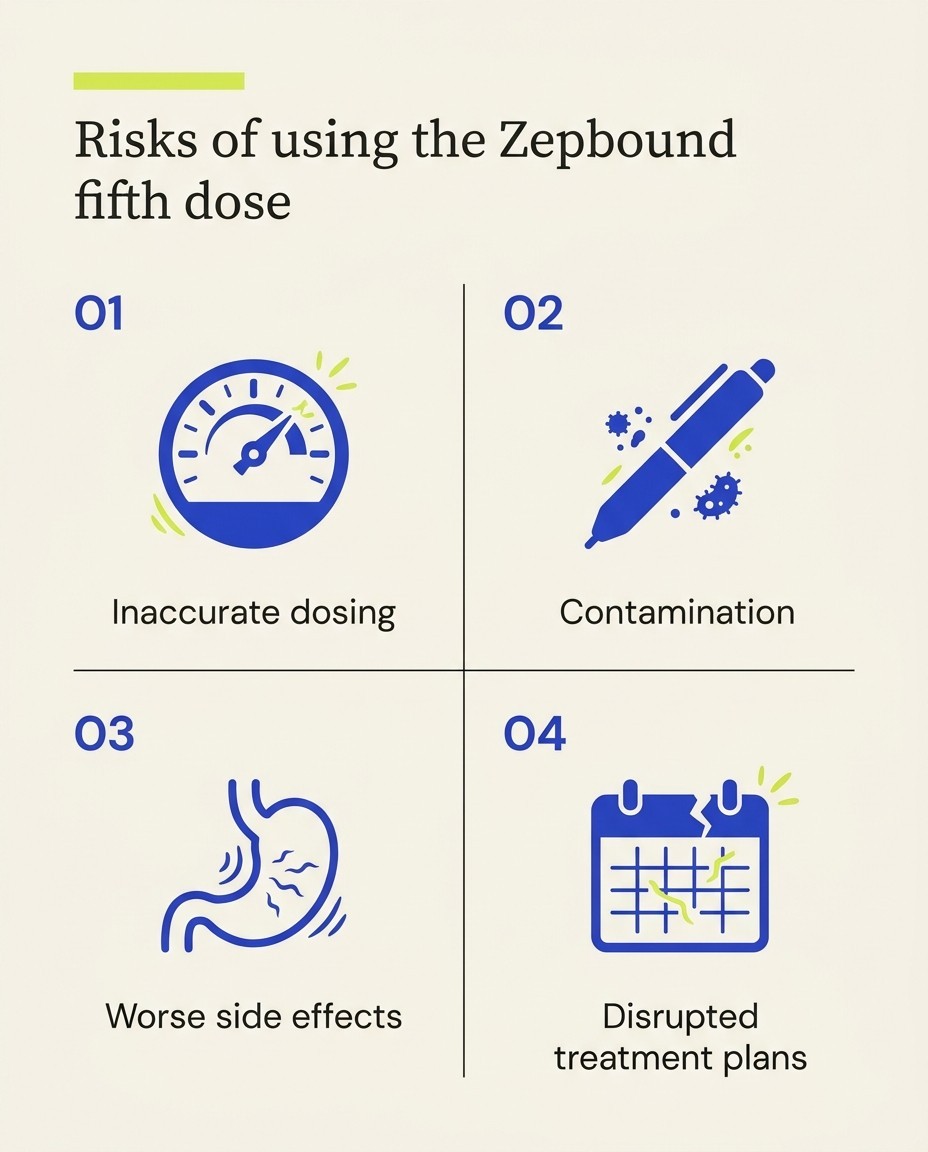
Splitting a Zepbound pen to squeeze out a fifth dose might sound clever, but it brings up real medical risks: not just getting the wrong amount, but contamination, unexpected side effects, and a treatment plan that could just stop working.
Inaccurate dosing: underdosing and overdosing
When you try to stretch a pen into five doses instead of four, you’re guessing at measurements. The pens don’t have markings for a fifth dose. You can’t just eyeball medication.
Incorrect dose administration was the most reported adverse event for tirzepatide between 2022 and 2025. Reports shot up from 1,248 in 2022 to 9,800 in 2024. That’s not a small jump.
If you underdose, you won’t get the blood sugar control or weight loss you’re hoping for. Your body needs consistent amounts to work right. Take less than prescribed, and you lose effectiveness.
Overdosing brings its own set of problems. Too much tirzepatide can cause nasty nausea, vomiting, and even dangerously low blood sugar (hypoglycemia), especially if you’re also on insulin or other diabetes meds. Symptoms of low blood sugar include shakiness, sweating, confusion, and dizziness. Hypoglycemia risk goes up if you’re on other glucose-lowering drugs.
Underdosing risks
Overdosing risks

Risk of contamination and sterility issues
The KwikPen is designed for four injections with a new sterile needle each time, within 30 days of first use. Drawing medicine out with a syringe means piercing the cartridge in a way it wasn’t designed for, and every extra entry is another chance for bacteria to get in.
Even after you clean your skin with an alcohol wipe, there’s still bacteria around. Going back into a pen to chase the last few drops is asking for trouble.
Contaminated meds can cause infections at your injection site or, worse, throughout your body. Reports of injection-site pain keep going up, with 9,849 cases in the FAERS database from 2022 to Q1 2025.
Sterility isn’t just a technicality. Drug companies make these pens in super-clean environments for a reason. Your kitchen table doesn’t cut it.
Potential side effects and adverse reactions
Tirzepatide already brings some side effects when used as directed. Nausea, vomiting, diarrhea, constipation: pretty standard as your body adjusts. Approximately 1 in 4 people experience nausea, particularly during dose escalation, though it typically improves within 2 to 4 weeks on a stable dose.

These side effects are usually normal and temporary:
- Mild nausea, especially in the first 1–2 weeks of a new dose
- Reduced appetite or feeling full quickly
- Mild diarrhea or constipation
- Slight fatigue as your body adjusts
These typically improve within 2–4 weeks on a stable dose. Eating smaller, bland meals and staying hydrated can help.
Mess with the dosing schedule, and you risk making those side effects worse. Gastrointestinal problems are still the most common adverse events, with 3,602 nausea reports in 2024 alone. Improper dosing just adds fuel to the fire.
Pancreatitis (inflammation of the pancreas) is rare but serious. Inconsistent or excessive dosing could make it more likely. If you get severe abdominal pain, especially pain that radiates to your back, get medical help right away. This could be a sign of pancreatitis, which needs urgent treatment.
Most adverse event reports come from women aged 40 to 59, the same group most likely to use tirzepatide for weight loss. Hospitalization is the most common outcome in safety reports, which isn’t something to shrug off.

Seek immediate medical help if you experience:
- Severe abdominal pain, especially radiating to your back (possible pancreatitis)
- Signs of allergic reaction: facial swelling, difficulty breathing, severe rash
- Severe or persistent vomiting that won’t stop
- Symptoms of very low blood sugar: confusion, fainting, severe shakiness
Call 911 for suspected allergic reactions or pancreatitis.
Impact on treatment effectiveness and safety
Doctors pick your dose based on evidence and careful scheduling. These numbers aren’t random. They’re there to give you results and keep side effects down.
Making your own fifth dose means ditching the schedule. Your body won’t respond the same to inconsistent amounts. Weight loss can stall or even backtrack. Blood sugar control gets unpredictable.
Healthcare providers say you should start with the lowest initial dose and go up slowly. Skipping steps or taking odd amounts defeats the whole point.
Safety relies on predictability. Your doctor needs to know exactly what you’re taking to help you. If you run into problems but don’t mention you’re using extra from the pen, they can’t give you the right advice.
Zepbound pens are built around fixed doses for a reason. The design protects you from dosing mistakes; it isn’t there to be annoying.
Guidance from clinicians and manufacturers
Zepbound works best with real medical oversight and clear instructions from the people who make and prescribe it. Getting the dose right isn’t just about a chart: it’s about monitoring, honest talks with your prescriber, and sticking to what’s tested and safe.
Official dosing schedule and pen disposal
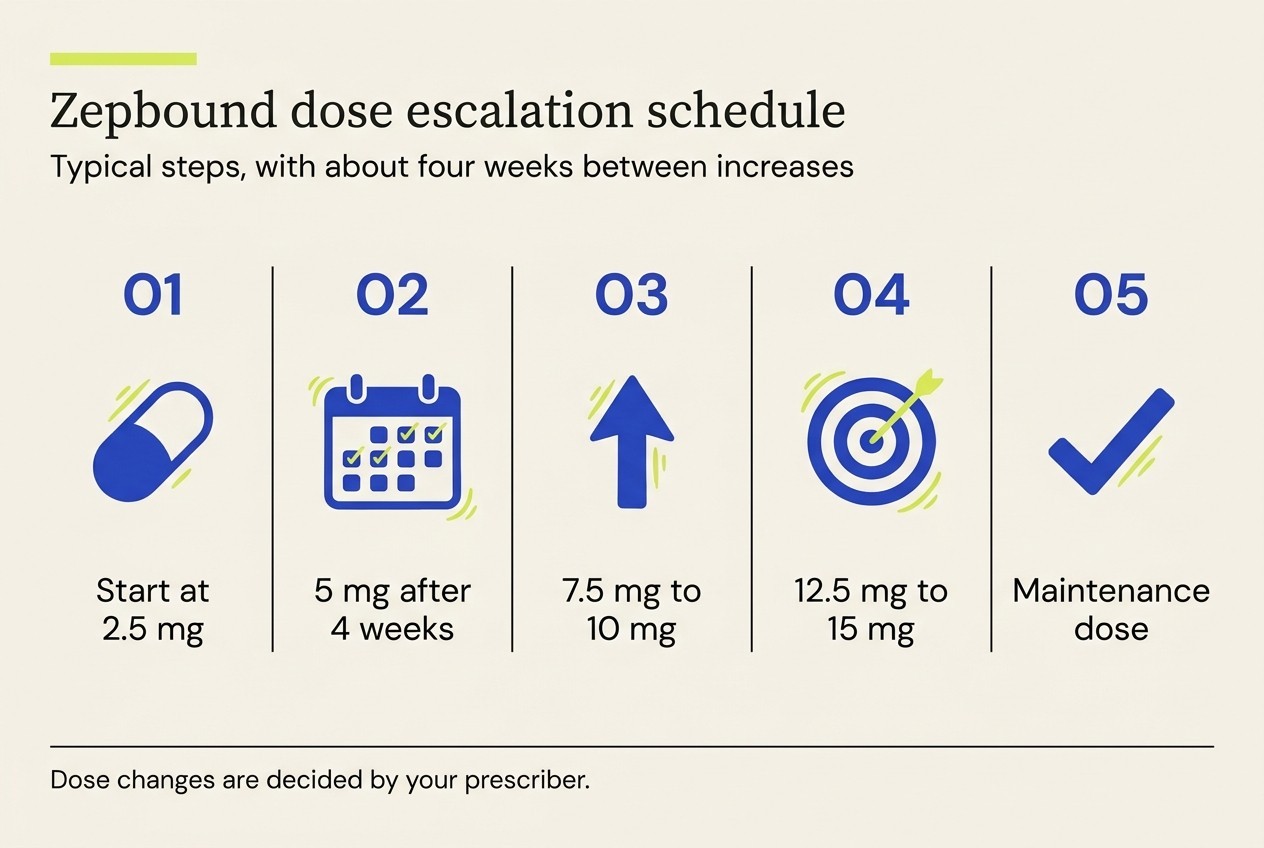
Eli Lilly lays out a specific escalation schedule for Zepbound, detailed in the Zepbound prescribing information. You start at 2.5 mg for four weeks, move to 5 mg, and can then go up in 2.5 mg steps at least four weeks apart. That slow ramp-up helps your body adjust and keeps side effects like nausea in check.
How you dispose of it depends on the form you use. A single-dose pen is thrown away after one injection. A KwikPen is thrown away after four doses, 30 days after first use, or a total of 30 days at room temperature, whichever comes first, even if there’s medicine left. Both go in an FDA-cleared sharps container.
Thinking about using leftover medication or stretching doses? Don’t. Clinical guidelines stress correct dosing, because even small mistakes can cause big issues. The pen is calibrated for its labeled doses, and trying to get more out of it is risky.
Don’t use insulin syringes or try to pull medication from the pens. That’s not what they’re made for.
The role of prescribers and clinical oversight
Your prescriber should check in with you regularly, usually every month or three. These aren’t just paperwork appointments. They’re a chance to see how you’re doing, tweak your treatment, and catch any side effects early.
A good prescriber asks about side effects, weight changes, and how you’re finding the injections. Proper clinical oversight means monitoring your response and adjusting based on real results, not just following a script.
Too many online providers barely offer more than basic dosing info. That’s not enough. You need support, especially when changing doses or dealing with side effects.
If your provider isn’t giving you that kind of support, it’s a red flag. Weight loss treatment needs real medical supervision.
Risks of self-medication and dose manipulation
Some people try to speed things up by jumping doses or taking more than prescribed. Others try to stretch medication by splitting pens or tweaking injection amounts.
Both approaches are risky. Dosing errors have led to hospitalizations, and some folks have dealt with severe gastrointestinal symptoms that drag on for days.
When you bypass the safety features built into the pen system, you’re guessing at dosage. That’s not worth it.
Self-medicating makes it easy to miss warning signs that something’s off. A clinician might spot patterns or symptoms that seem harmless to you but actually mean you need to pause or adjust treatment.
Key risks of dose manipulation:
- Overdosing can cause severe nausea, vomiting, and even hospitalization.
- Underdosing makes the medication less effective for no good reason.
- Contamination risks crop up when people try to access medication the wrong way.
- Missing contraindications or drug interactions that your clinician would normally catch.
Stick with your prescribed dosing schedule. If you think something needs to change, talk to your prescriber first. There’s usually a safer way to sort things out.
Alternative strategies and personalized treatment for sustainable weight loss
Finding the right dose is just one piece of the puzzle. Long-term success with Zepbound depends on safe adjustments, breaking through stalls, and building habits that support your body beyond the injection.
Making dose adjustments safely
People often rush their dose increases, hoping for faster results. That’s not how this works.
Zepbound uses a structured escalation schedule for a reason. Your body needs time to adjust at each new dose.

Most folks start at 2.5mg and increase every four weeks if things go smoothly, as outlined in the Zepbound prescribing information. Here’s how safe progression usually looks:
-
Start at 2.5mg for at least four weeks.
-
Move to 5mg only after your body has adapted.
-
Continue stepping up if needed (7.5mg, 10mg, 12.5mg, 15mg), in 2.5mg steps at least four weeks apart.
-
Stay at your current dose if you’re dealing with significant side effects.
Never increase your dose early, even if weight loss feels slow. Your provider needs to check your response and any side effects before bumping you up. Jumping ahead can trigger nausea, vomiting, and other issues that might force you to stop treatment altogether.
Some people find their sweet spot at 5mg or 10mg and stay there as their maintenance dose. You don’t always need the highest dose to see results. The FDA label lists 5mg, 10mg or 15mg as maintenance doses, and your prescriber will help you decide which level gives you the best balance of effectiveness and tolerability.
Work with your prescriber to figure out what your body responds to best.
Addressing weight loss plateaus
Almost everyone on Zepbound hits a weight loss plateau at some point. It’s frustrating, but it doesn’t mean the medication isn’t working anymore.
Your body adapts as you lose weight. Metabolism slows a bit, and you need fewer calories to maintain your new size.
If you’ve hit a weight loss plateau, try these steps:
To break through a weight loss plateau:

Don’t panic or make drastic changes. Plateaus happen and they’re just part of the process.
Lifestyle factors: physical activity and hydration
Zepbound isn’t a magic fix that works while you do nothing. Physical activity and staying hydrated make a real difference.
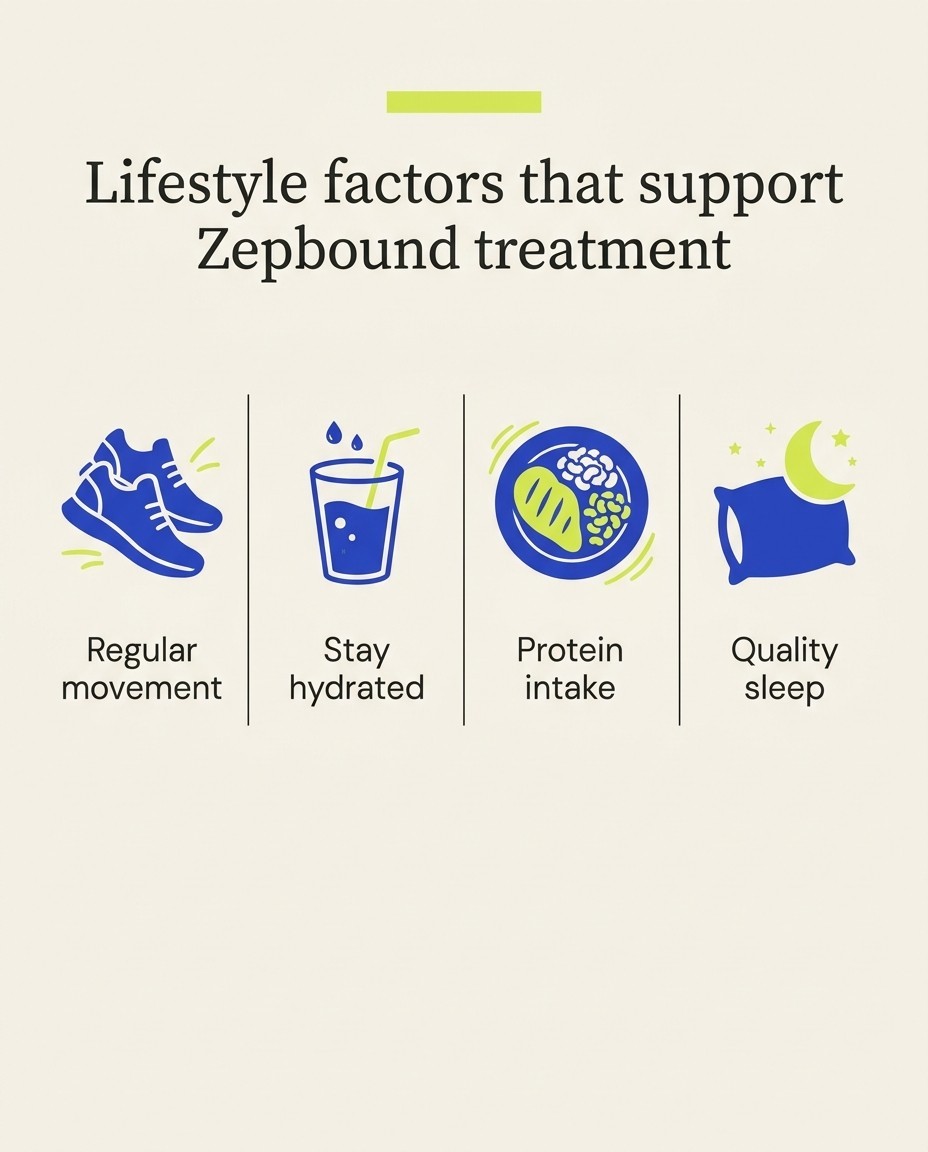
You don’t need to become a gym fanatic. Walking 30 minutes most days, taking the stairs, or just moving in ways you actually enjoy all count.
Movement helps you keep muscle mass while losing weight and supports your metabolism. Hydration matters more than most people realize. Zepbound can slow digestion, so drinking enough water helps with constipation and keeps your body running smoothly.
Aim for at least 68 fluid ounces (about 8½ cups) of water daily, more if you’re active or experiencing digestive side effects like constipation, where 68 to 100 fluid ounces daily can help.
These factors work together:
| Factor | Why it matters |
|---|---|
| Regular movement | Maintains muscle, boosts mood, supports metabolism |
| Adequate water | Reduces side effects, aids digestion, supports kidneys |
| Protein intake | Aim for 1.0–1.2g per kilogram of body weight (about 0.45–0.55g per pound) daily during active weight loss (for example, roughly 80–100g daily if you weigh 180 lb) to preserve lean tissue |
| Sleep quality | Affects hunger hormones and recovery |
Personalized treatment means tweaking these elements to fit your life. You don’t have to follow a strict plan that doesn’t suit you.
Considering other GLP-1 medications
Zepbound isn’t your only option for weight management. Other GLP-1 medications might suit you better, depending on how you respond and what you prefer.
Semaglutide, sold as Wegovy for weight loss, works in a similar way but targets only GLP-1 receptors rather than both GLP-1 and GIP. Some people find they respond better to one than the other. Clinical trials show semaglutide achieves meaningful weight reduction for many people.
Zepbound tends to produce slightly higher average results, but that’s not the whole story. In clinical trials, tirzepatide showed 15 to 22.5% average body weight loss over 72 weeks (SURMOUNT-1), compared with approximately 15% for semaglutide over 68 weeks (STEP 1). Individual results vary significantly, and some people respond better to one medication than the other.
Liraglutide (Saxenda) is another alternative, though it requires daily injections instead of weekly ones, which can be a hassle for some.
Zepbound may be better if:
-
You want to maximize weight loss potential
-
You also have type 2 diabetes (tirzepatide’s dual GLP-1 and GIP action helps blood sugar too; for diabetes it’s sold as Mounjaro)
-
You’re comfortable with a newer medication
Wegovy may be better if:
-
You want a medication with a longer track record
-
Zepbound isn’t available or affordable for you
-
You experienced difficult side effects with Zepbound
Saxenda may be better if:
-
You prefer a lower starting dose with very gradual escalation
-
Weekly injections don’t suit your routine
If Zepbound isn’t working for you after several months at a decent dose, talk to your prescriber about switching. Everyone’s body chemistry is a little different, and sometimes finding the right medication takes some trial and error.
There’s no shame in trying something else if your current treatment just isn’t delivering sustainable weight loss, even when you’re following the plan.
Frequently asked questions
What is the Zepbound golden dose?
The “golden dose” refers to leftover tirzepatide found in Zepbound KwikPens after the labeled dose has been used. Each KwikPen holds extra volume so it can be primed before every dose, but some people extract this extra medication for an additional injection. The Zepbound Instructions for Use say to throw the pen away after four doses, including any medicine left inside, as it carries risks of inaccurate dosing and contamination.
Is it safe to use the fifth dose from a Zepbound pen?
No. Using the overfill from a Zepbound KwikPen is not recommended by the manufacturer or prescribers. The extra volume is for priming, and drawing medicine out with a syringe isn’t how the pen is designed to be used. You also cannot measure the leftover amount accurately, which means you risk underdosing or overdosing. Incorrect dose administration was the most commonly reported adverse event for tirzepatide between 2022 and 2025.
How do I find my optimal Zepbound dose?
Work with your prescriber to follow the standard escalation schedule: start at 2.5mg for four weeks, then increase gradually every four weeks based on your response and tolerability. Your optimal dose is the one where you experience meaningful appetite suppression and weight loss with manageable side effects. This could be anywhere from 5mg to 15mg; there is no single “right” dose for everyone.
What are the maintenance doses for Zepbound?
The FDA label lists the maintenance doses for Zepbound as 5mg, 10mg, or 15mg once weekly. Your prescriber chooses one based on your response and tolerability. After the initial 2.5mg starting dose, your prescriber will increase your dose gradually. The maximum dose is 15mg once weekly. Not everyone needs the highest dose to see good results.
Can I stay on a lower Zepbound dose if it’s working?
Yes. If you’re experiencing good appetite control and steady weight loss at a lower dose with manageable side effects, there is no requirement to keep increasing. Discuss this with your prescriber; they can help you decide whether to stay at your current dose or continue escalating based on your progress and goals.
What should I do if Zepbound stops working for me?
If you hit a weight loss plateau, first review your diet and activity levels honestly, as portions and habits can shift over time. Give it at least four to six weeks before assuming the medication has stopped working. If the plateau persists, speak to your prescriber about a dose increase or switching to an alternative GLP-1 medication such as semaglutide (Wegovy).
How do I use a Zepbound injector pen correctly?
It depends on the form. A single-dose pen holds one dose: you place it on your skin, press and hold, then throw it away. A KwikPen holds four weekly doses: each week you attach a new needle, prime the pen, turn the dose knob until it stops, and inject into your stomach, thigh, or upper arm. Follow the Instructions for Use that come with your pen. Never try to extract additional medication from the pen using insulin syringes or other devices. Your prescriber or pharmacist can walk you through the process if you are unsure.
What are the most common side effects of Zepbound?
The most common side effects are gastrointestinal: nausea (affecting approximately 1 in 4 people), vomiting, diarrhea, and constipation. These are usually worst during the first few weeks after starting or increasing a dose and typically improve within 2 to 4 weeks on a stable dose. Eating smaller, bland meals and staying well hydrated can help manage symptoms.
Is Zepbound covered by insurance?
It depends on your plan. Coverage for weight management medication varies, and many plans that cover Zepbound need prior authorization first. If your plan doesn’t cover it, Lilly sells Zepbound vials and the KwikPen for self-pay through LillyDirect, starting at $299 a month for the 2.5 mg dose (Healio).
Should I try the golden 5th dose to save money on Zepbound?
No. While the desire to reduce costs is understandable, extracting the golden 5th dose from Zepbound pens carries genuine risks including contamination, inaccurate dosing, and disrupted treatment effectiveness. If cost is a barrier, speak to your prescriber about insurance coverage, self-pay options through LillyDirect, or alternative medications that may be more affordable. Your safety matters more than stretching a prescription.
The bottom line
The Zepbound golden dose might sound like a clever way to get more from your prescription, but the risks outweigh any potential savings. Inaccurate dosing, contamination, and disrupted treatment plans are real concerns that clinicians take seriously. Your true optimal dose is the one your prescriber helps you find through the standard escalation schedule, not something you extract from a used pen. If your current dose is not delivering the results you want, talk to your prescriber about safe adjustments or alternative GLP-1 medications rather than experimenting on your own.
This article is for informational purposes only and does not replace professional medical advice, diagnosis, or treatment. Always speak to your doctor or prescriber before starting, stopping, or changing any weight loss medication. If you are experiencing side effects or are unsure about your dose, contact your healthcare provider.
Sources: Zepbound prescribing information, Medication Guide and Instructions for Use (DailyMed), SURMOUNT-1 trial, STEP 1 trial, FDA approval of the Zepbound KwikPen (Healio)